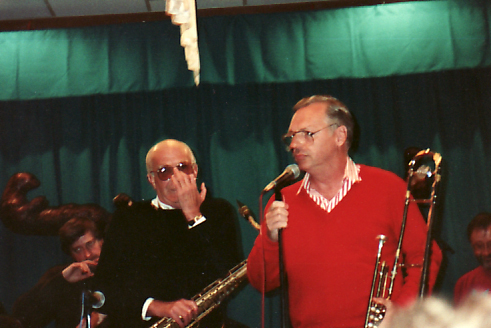
Rob McConnell (1935-2010)
Biography
Robert Murray Gordon McConnell was born in London, Ontario, Canada, and became one of North America’s finest big band leaders and arrangers. He played valve trombone and led the Boss Brass, an all-brass and rhythm big band, for over 40 years. McConnell arranged for various artists and ensembles while maintaining the Boss Brass as his primary vehicle. The band won Grammy Awards and earned widespread acclaim for its tight ensemble work and McConnell’s sophisticated arrangements. His work combined Canadian and American jazz traditions, demonstrating that jazz excellence flourished outside major U.S. centers. McConnell influenced Canadian jazz significantly and proved that regional scenes could produce world-class musicians and arrangers. His Boss Brass became one of jazz’s most distinctive big bands through its unusual all-brass instrumentation and McConnell’s excellent writing.
Musical Style
McConnell’s arranging style featured excellent brass writing combining sophisticated harmonies with strong swing feeling, showcasing the possibilities of all-brass instrumentation. His arrangements demonstrated complete mastery of brass voicing, creating rich, varied textures using only brass and rhythm section. What distinguished McConnell’s work was his ability to avoid monotony with limited timbral palette—his arrangements featured such variety in register, articulation, and dynamics that the lack of saxophones never felt limiting. His voicings were sophisticated yet accessible, incorporating contemporary harmonies while maintaining clarity and swing. McConnell’s harmonic language balanced tradition and innovation. His arrangements featured strong melodies and logical development, always serving musical communication. McConnell’s style represented Canadian jazz: sophisticated, professional, and proving that excellence wasn’t limited to American musicians.
Orchestration Techniques
McConnell’s orchestration for all-brass ensemble exploits the full timbral range of brass instruments, employing muted versus open voicings, varied articulations, and registral contrasts to compensate for the absence of saxophone colors. His voicing approach utilizes spread voicings across the brass section with careful attention to overtone blending: root in bass trombone, fifth in tenor trombones, thirds and sevenths in trumpets, and upper extensions in lead trumpet, creating vertical structures that maximize harmonic clarity and brass resonance. Sectional writing substitutes for missing saxophone timbre through strategic use of muted brass: cup-muted trumpets functioning as alto section, straight-muted trombones providing tenor-like warmth, or harmon-muted trumpets creating reedy, saxophone-like effects. Instrumental combinations create variety through dynamic contrast and articulation: legato flugelhorn sections against staccato trumpet figures, or sustained bass trombone pedals supporting melodic valve trombone statements. Contrapuntal techniques include sophisticated brass choir writing with four or more independent voices moving through chromatic sequences, each voice maintaining melodic interest while contributing to harmonic progression, a technique demanding exceptional section precision. Register exploitation spans the full brass range from bass trombone pedal tones to screaming lead trumpet, with McConnell strategically alternating registral placement to avoid timbral fatigue and maintain listener interest despite limited instrument palette. Rhythmic notation emphasizes varied articulations (staccato, legato, marcato, accented) that create rhythmic variety and textural interest, compensating for timbral uniformity through rhythmic sophistication. Textural approaches range from unison brass lines for power to complex five or six-part voicings, with McConnell creating illusion of larger ensemble through careful orchestration. His ensemble configuration—five trumpets, four trombones (including bass trombone), and rhythm section—maximizes brass possibilities while maintaining big band proportions. Dynamic architecture employs extreme dynamic range from pianissimo muted passages to fortissimo open brass climaxes, using volume contrast as primary structural device in absence of timbral variety.
Top Albums
Rob McConnell and the Boss Brass - “Big Band Jazz” (1979)
McConnell’s arrangements for the Boss Brass showcase his distinctive approach to all-brass big band. His charts feature sophisticated voicings creating remarkable variety from brass-only instrumentation. What makes these arrangements notable is their success at overcoming limitations—McConnell proves that brass alone can create full, varied big band sounds. His arrangement of standards alongside originals demonstrates his versatility and his respect for tradition. The album won Grammy and established the Boss Brass’s international reputation.
Rob McConnell and the Boss Brass - “Overtime” (1983)
McConnell’s arrangements here demonstrate his mature style. His charts maintain the Boss Brass’s signature sound while incorporating more contemporary elements. What’s particularly impressive is McConnell’s continued finding of fresh possibilities in brass-only writing—these arrangements show evolution beyond earlier work while maintaining the band’s essential character. His composition “Overtime” showcases his gifts for creating memorable themes with sophisticated brass orchestration. The album represents peak Boss Brass.
Rob McConnell and the Boss Brass - “Our 25th Year” (1993)
McConnell’s arrangements celebrating the band’s longevity demonstrate sustained quality over decades. His charts feature his signature sophisticated brass writing with perhaps even greater maturity and economy. What makes these arrangements fascinating is their perfect balance—McConnell achieves maximum musical interest while maintaining the accessibility and swing that defined the Boss Brass. His arrangement of “Tribute to Basie” shows his respect for tradition while maintaining his distinctive voice. The album demonstrates McConnell’s sustained excellence throughout his career.