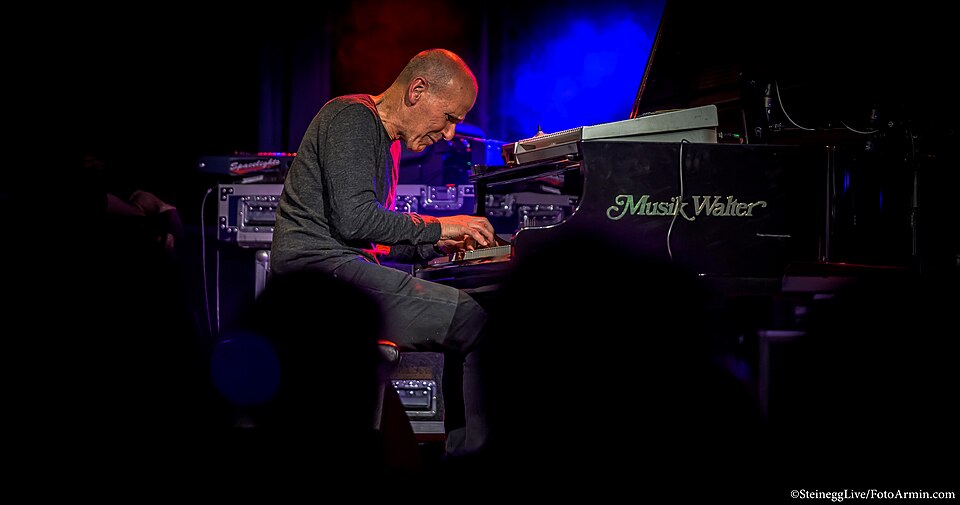
Russell Ferrante (b. 1952)
Biography
Russell Ferrante was born in San Jose, California, and became a founding member and principal composer-arranger for the Yellowjackets, one of contemporary jazz’s most successful groups. He studied music formally before establishing himself as keyboardist and composer. Since the Yellowjackets’ formation in 1981, Ferrante has been central to the group’s musical identity, contributing compositions and arrangements that define their sound. The band has won multiple Grammy Awards and achieved remarkable commercial success while maintaining jazz credibility. Ferrante’s work demonstrates that sophisticated jazz arranging can reach wide audiences without compromising musical substance. His success with the Yellowjackets shows that small group arranging remains vital and commercially viable when executed at the highest levels.
Musical Style
Ferrante’s arranging style for the Yellowjackets combines jazz sophistication with contemporary grooves and production, featuring sophisticated harmonies, memorable melodies, and tight ensemble writing. His arrangements demonstrate complete understanding of small group dynamics and the specific capabilities of his bandmates. What distinguishes Ferrante’s work is its balance between sophistication and accessibility—his charts feature complex harmonies and rhythms yet remain melodic and engaging for broader audiences. His voicings make effective use of limited instrumentation (saxophone, keyboards, bass, drums), creating full sounds from small forces. Ferrante’s harmonic language draws from jazz tradition while incorporating contemporary production techniques and pop sensibilities. His arrangements feature strong compositional material—memorable melodies and logical structures. Ferrante’s style represents contemporary fusion at its best: sophisticated, accessible, and musically substantial.
Orchestration Techniques
Ferrante’s orchestration for small group maximizes timbral variety through strategic use of keyboard textures, employing synthesizer pads, electric piano comping, and acoustic piano voicings to create harmonic density typically achieved by larger ensembles. His voicing approach utilizes extended chord structures (ninths, elevenths, thirteenths) voiced in open position across the keyboard’s full range, with careful attention to how these voicings complement saxophone timbre without masking it. Sectional writing in his quartet context requires saxophone to function as both melodic voice and harmonic contributor, with Ferrante writing passages where keyboard and saxophone voice chords together in rhythmic unison, creating pseudo-big band effect from limited forces. Instrumental combinations exploit the specific capabilities of his quartet: saxophone sustained tones against syncopated keyboard stabs, bass ostinatos supporting saxophone-keyboard unisons, or layered synthesizer textures providing harmonic backdrop for melodic improvisation. Contrapuntal techniques include two-voice counterpoint between saxophone and keyboard, with bass providing independent third voice, creating polyphonic density that belies the group’s small size. Register exploitation is strategic: saxophone operates across its full range from subtone low notes to altissimo, keyboards span from bass register pads to high melodic fills, ensuring full frequency spectrum coverage despite limited instrumentation. Rhythmic notation reflects contemporary fusion practices, with specific groove patterns notated precisely including syncopated bass lines, anticipated chord changes, and backbeat accents that define the style’s rhythmic foundation. Textural approaches alternate between sparse, spacious passages featuring individual instrument colors and dense, layered sections where all instruments contribute simultaneously to create orchestral fullness. His ensemble configuration—saxophone, keyboards, bass, drums—prioritizes flexibility and timbral variety over sheer volume, allowing for dynamic subtlety. Dynamic architecture follows pop-influenced verse-chorus structures with builds achieved through additive layering, rhythmic intensification, and registral expansion rather than merely volume increase, reflecting studio production sensibilities.
Top Albums
Yellowjackets - “Yellowjackets” (1981)
Ferrante’s arrangements for the group’s debut album establish their distinctive sound. His charts feature sophisticated harmonies with contemporary grooves and polished production. What makes these arrangements notable is their freshness—Ferrante helped create a new sound in jazz-fusion that was sophisticated yet accessible. His composition “Imperial Strut” demonstrates his gift for creating memorable melodies with sophisticated harmonic settings and strong grooves. The album launched the Yellowjackets as major force in contemporary jazz.
Yellowjackets - “Politics” (1988)
Ferrante’s arrangements here demonstrate the group’s mature sound. His charts maintain sophisticated jazz harmonies while incorporating contemporary production and world music influences. What’s particularly impressive is Ferrante’s continued evolution—these arrangements show growth beyond the debut while maintaining the group’s essential identity. His composition “Statue of Liberty” showcases his ability to create extended forms that sustain interest through development. The album won Grammy and represents peak Yellowjackets.
Yellowjackets - “Timeline” (2011)
Ferrante’s later arrangements show sustained creativity over three decades. His charts maintain the group’s signature blend of sophistication and accessibility while incorporating contemporary touches. What makes these arrangements fascinating is their maturity—Ferrante’s decades of experience result in writing of remarkable economy and effectiveness. His composition “Claire’s Song” demonstrates his continued melodic gifts and his understanding of how to create emotionally direct music within sophisticated frameworks. The album won Grammy and proves the Yellowjackets remained vital and creative, continually finding fresh approaches to contemporary jazz.