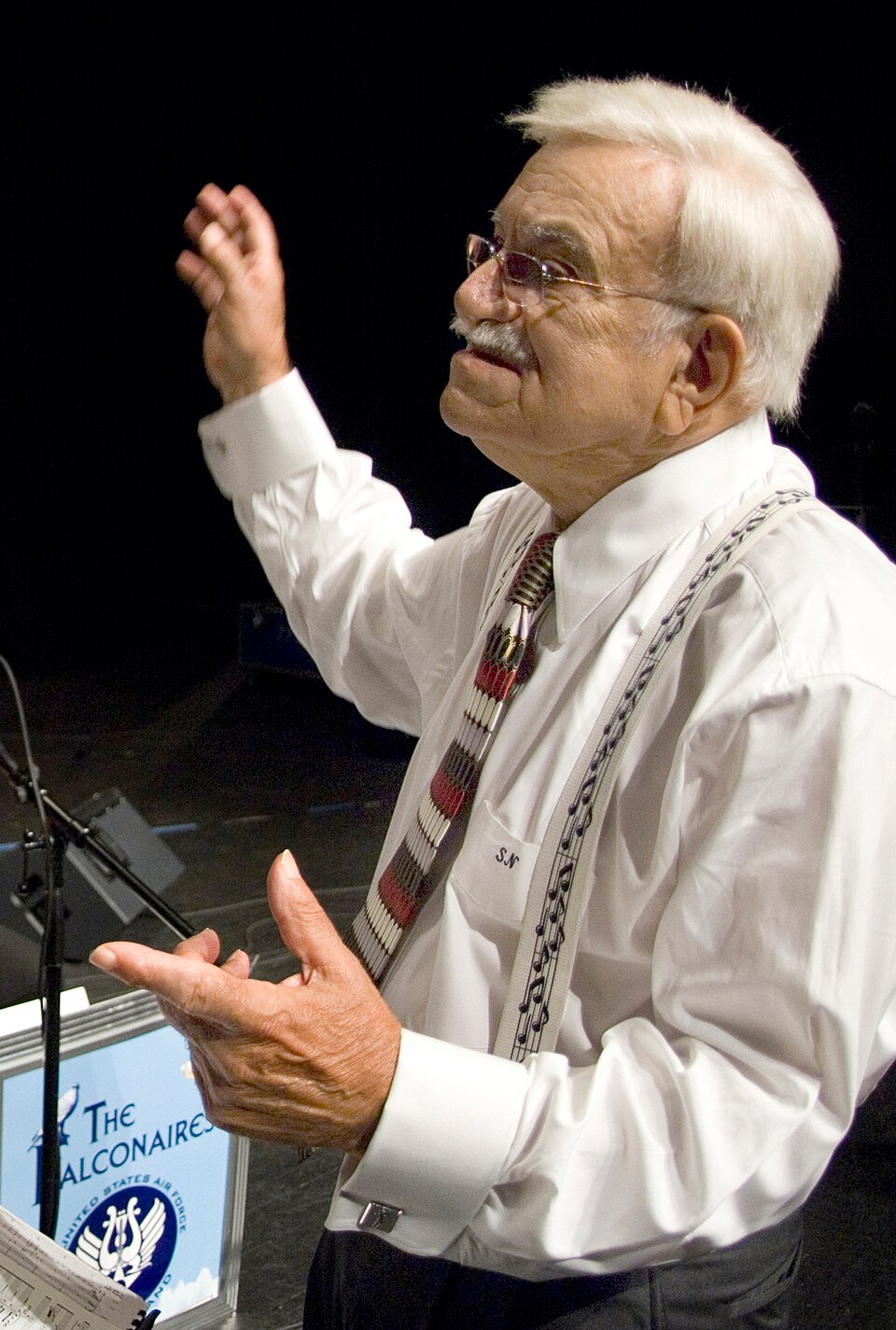
Sammy Nestico (1924-2021)

Biography

Samuel Nestico was born in Pittsburgh and became one of the most important big band arrangers of the post-swing era. He served as chief arranger for the U.S. Marine Band and later the Airmen of Note, bringing jazz sophistication to military ensembles. Nestico became Count Basie’s primary arranger in the 1960s-80s, writing charts that maintained the Kansas City tradition while sounding contemporary. His arrangements for Basie became band signatures. Beyond professional work, Nestico’s educational arrangements are performed by school and college bands worldwide, influencing generations of student musicians. He received NEA Jazz Master honors and numerous awards. Nestico’s work demonstrated that jazz traditions could remain vital through thoughtful updating. His educational contributions ensured big band jazz reached young musicians globally.

Musical Style

Nestico’s arranging style featured clear, swinging arrangements with memorable melodies rooted in the Count Basie tradition while incorporating contemporary elements. His charts demonstrated complete mastery of big band writing, with excellent section work, sophisticated voicings, and strong formal structures. What distinguished Nestico’s work was his clarity—his arrangements were always transparent and logical, serving the music without unnecessary complexity. His writing for Basie maintained the band’s essential simplicity and swing while adding harmonic sophistication. Nestico understood how to write memorable melodies and create exciting ensemble passages that featured the band’s strengths. His educational arrangements distilled professional techniques into playable charts for students, demonstrating that quality needn’t be sacrificed for accessibility. Nestico’s style represented the continuation of Kansas City swing tradition into contemporary times.

Orchestration Techniques

Nestico’s orchestrations exemplify the Basie school of transparent big band writing, employing four-way close voicings for saxophone section with the baritone doubling the lead at two octaves below to create a unified, powerful sound. His brass writing utilizes the characteristic Kansas City approach of open voicings with wide spacing between trumpet and trombone sections, allowing each choir to maintain distinct identity while blending seamlessly. Sectional writing emphasizes the antiphonal call-and-response patterns fundamental to swing arranging, with brass and saxophones trading phrases in rhythmic dialogue separated by strategic rests. Contrapuntal techniques focus on simplicity and effectiveness, using basic counterpoint principles such as parallel thirds and sixths between sections during background figures, ensuring harmonic support without obscuring the primary melodic line. Nestico’s register usage keeps all instruments in their most comfortable ranges, with lead trumpet rarely exceeding high C and saxophone section staying centered in middle registers where blend and intonation are most reliable. His brass voicings favor open fifths and octaves in the lower brass, providing solid harmonic foundation while upper trumpets add brightness without harshness. Rhythmic notation is precise yet accessible, with clear articulation markings that convey swing interpretation without requiring excessive explanation, making his charts ideal for both educational and professional contexts. Textural approaches favor clarity over density, with orchestrations that allow rhythm section prominence, reflecting the Basie philosophy that the band breathes and swings most effectively when not cluttered with excessive horn writing. Nestico’s preferred configuration is the standard Basie instrumentation with four trumpets, three trombones, and five saxophones, maximizing the tried-and-true voicings that defined the Kansas City sound. Dynamic architecture employs the classic Basie technique of building from piano to fortissimo through orchestrational layering rather than pure volume increases. His signature technique involves writing unison or octave brass figures over sustained saxophone pads, creating forward motion and excitement while maintaining the harmonic foundation, a simple yet effective device that defines much of his work’s rhythmic energy.

Top Albums

Count Basie Orchestra - “Basie-Straight Ahead” (1969)

Nestico’s arrangements for Basie showcase his gift for writing in the Kansas City tradition. His charts including “Ya Gotta Try… Harder” feature the essential Basie qualities—simplicity, swing, blues feeling—while incorporating contemporary touches. What makes Nestico’s Basie arrangements remarkable is their faithfulness to the band’s character while updating the sound. His writing maintains the clarity and directness that defined Basie’s approach. The voicings demonstrate Nestico’s understanding of how to honor tradition while keeping it fresh.

Count Basie Orchestra - “Prime Time” (1977, Nestico arrangements)

Nestico’s arrangements here demonstrate his mature style with Basie. His charts feature excellent section writing, sophisticated yet clear voicings, and strong swing feeling. What’s particularly impressive is how Nestico writes contemporary-sounding music that nonetheless remains unmistakably Basie. His composition “Wind Machine” showcases his gift for creating exciting, swinging charts that feature the entire band. The album represents Nestico at peak form, creating some of the later Basie band’s finest recordings.

Sammy Nestico - “Fun Time and More” (educational charts)

Nestico’s educational arrangements demonstrate his gift for writing accessible yet substantial music. His charts teach important concepts while remaining musically satisfying—they’re not merely pedagogical exercises but genuine musical experiences. What makes Nestico’s educational work significant is its quality—he never condescends to student musicians but writes real jazz that happens to be playable at various levels. These arrangements have introduced countless young musicians to big band jazz, ensuring the tradition’s continuation. The work represents Nestico’s lasting contribution beyond his professional arranging.