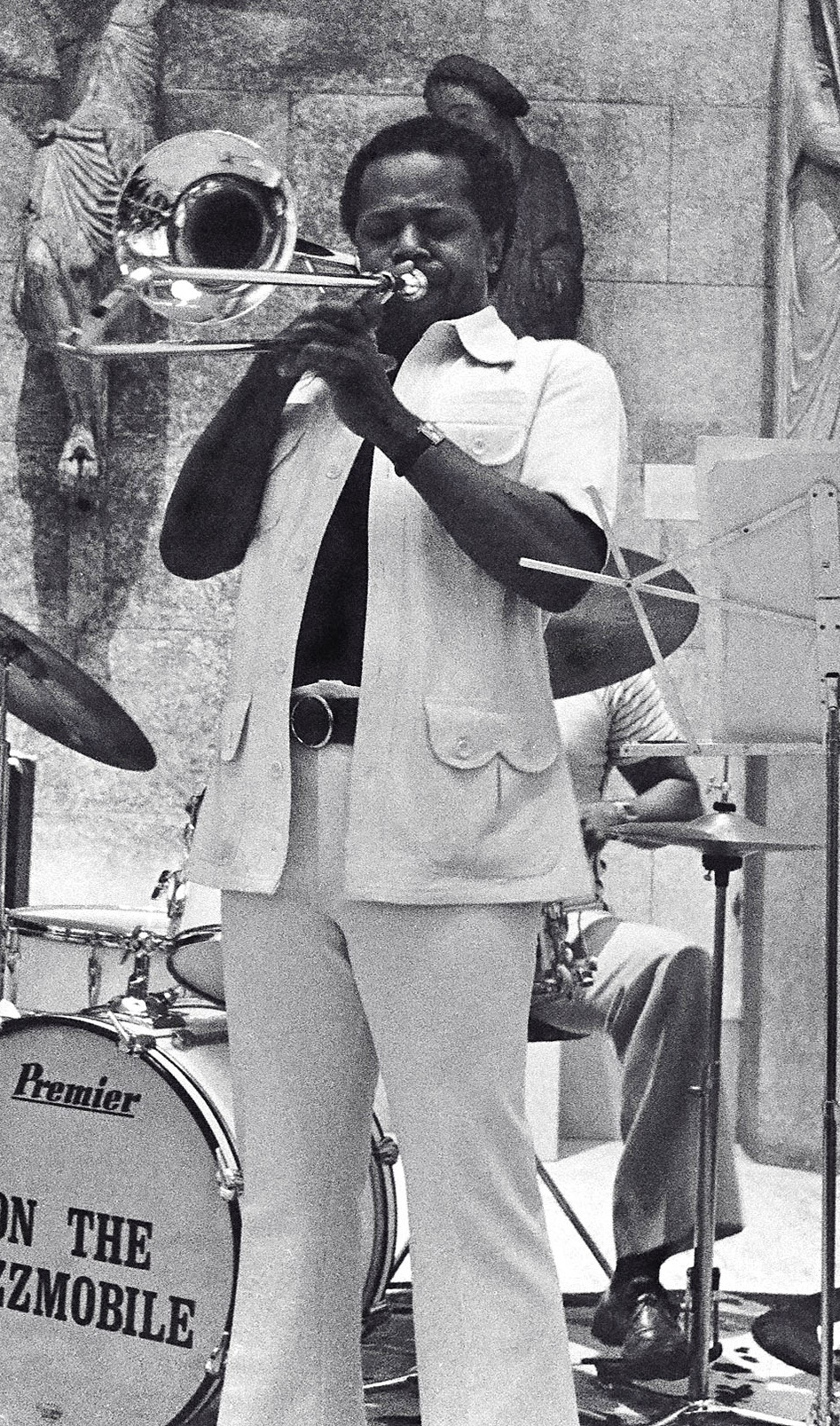
Slide Hampton (b. 1932)
Biography
Locksley Wellington “Slide” Hampton was born in Jeannette, Pennsylvania, into the Hampton family jazz dynasty. He played trombone and arranged for Maynard Ferguson’s band, Dizzy Gillespie, and numerous others while leading his own groups including the Slide Hampton Octet and the World of Trombones. Hampton lived in Europe for many years, working extensively with European jazz musicians. He won Grammy Awards and received NEA Jazz Master honors. Hampton continued arranging and performing into his 90s with remarkable vitality. His compositions and arrangements are performed worldwide. Hampton’s work balances bebop foundations with contemporary approaches, maintaining high musical standards across seven decades. His longevity and consistent quality demonstrate sustained creativity and dedication to jazz at the highest levels.
Musical Style
Hampton’s arranging style features sophisticated harmonies rooted in bebop tradition combined with excellent brass writing and contemporary approaches. His arrangements demonstrate complete technical mastery, with complex voicings that remain transparent and swinging. What distinguishes Hampton’s work is his melodic gift—his arrangements feature strong, memorable melodic content alongside sophisticated harmonies. As a brass player, Hampton understands sectional balance and blend intimately, creating rich yet clear brass textures. His voicings often feature close harmonies and interesting inner voice movement. Hampton writes intelligently for improvisers, creating frameworks that enhance soloists while maintaining compositional interest. His style balances tradition and innovation, honoring bebop heritage while incorporating contemporary elements. Hampton’s arrangements represent the continuation of bebop arranging tradition into the 21st century.
Orchestration Techniques
Hampton’s orchestrations demonstrate deep understanding of brass sonority derived from his mastery of trombone, employing close-position voicings that exploit the natural blend of brass instruments when scored in similar registers. His voicing approach utilizes sophisticated drop voicings and spread structures that create maximum resonance, often positioning trombones in their rich tenor register while trumpets provide brightness above. Sectional writing demonstrates bebop sensibilities applied to ensemble contexts, with unison lines that break into harmonized passages at cadential points, creating the characteristic bebop arrangement sound where complexity emerges from deceptively simple textures. Contrapuntal techniques include elaborate two-part inventions where brass lines interweave, often using intervallic cells (minor thirds, tritones) that are developed through inversion and augmentation, reflecting Hampton’s study of bebop melodic construction. His register usage exploits the full range of brass instruments, from bass trombone pedal tones to stratospheric trumpet passages, but always in service of musical expression rather than display. Hampton’s brass voicings frequently employ the “locked hands” technique adapted for brass, where all parts move in rhythmic unison while maintaining close harmonizations. Rhythmic notation reflects bebop precision with specific articulation markings for phrase shapes, including the characteristic bebop approach of accenting offbeats and employing legato eighth-note lines. Textural approaches favor medium density where each voice remains audible, avoiding both excessive thickness and transparency, allowing the intricate inner voice movement characteristic of his arrangements to be heard. Hampton’s preferred configurations include octets and nonets that provide harmonic fullness while maintaining chamber music clarity. Dynamic architecture employs bebop-influenced sudden dynamic shifts, with subito piano passages followed by explosive tutti statements that create dramatic tension. His signature technique involves harmonizing bebop lines in parallel fifths and fourths rather than traditional thirds, creating an open, modern sound that distinguishes his work from more conventional big band arranging, a technique that produces harmonies simultaneously rooted in bebop vocabulary yet harmonically forward-looking.
Top Albums
Slide Hampton Octet - “Sister Salvation” (1960)
Hampton’s early arrangements for octet demonstrate his gifts already fully developed. His charts feature sophisticated bebop harmonies with excellent brass writing and strong compositional structures. What makes these arrangements remarkable is their perfect balance between written material and improvisation—Hampton provides substantial composition while leaving room for extended solos. His composition “Sister Salvation” showcases his melodic gifts and his understanding of how to develop themes through arrangement. The voicings prove Hampton’s early mastery of small-to-medium ensemble writing.
Slide Hampton and the Jazz Masters - “World of Trombones” (1979)
Hampton’s arrangements for trombone ensemble demonstrate his understanding of his instrument and his gifts for unusual instrumentation. His charts create rich, varied textures using only trombones (plus rhythm), proving that limitations can inspire creativity. What’s particularly impressive is how Hampton avoids monotony—his arrangements feature such variety in register, articulation, and dynamics that the uniform timbre never becomes tedious. His arrangement of “Confirmation” shows how bebop classics can be completely reimagined. The album represents a unique contribution to jazz arranging.
Slide Hampton - “Spirit of the Horn” (2006)
Hampton’s later arrangements for various configurations show sustained creativity into his 70s. His charts maintain bebop foundations while incorporating contemporary touches. What makes these arrangements fascinating is their maturity—Hampton’s decades of experience result in writing of remarkable clarity and effectiveness. His composition “Frame for the Blues” demonstrates how tradition can remain vital through skilled handling. The album proves Hampton remained creative and relevant throughout his long career, continuing to produce work of substance and beauty.