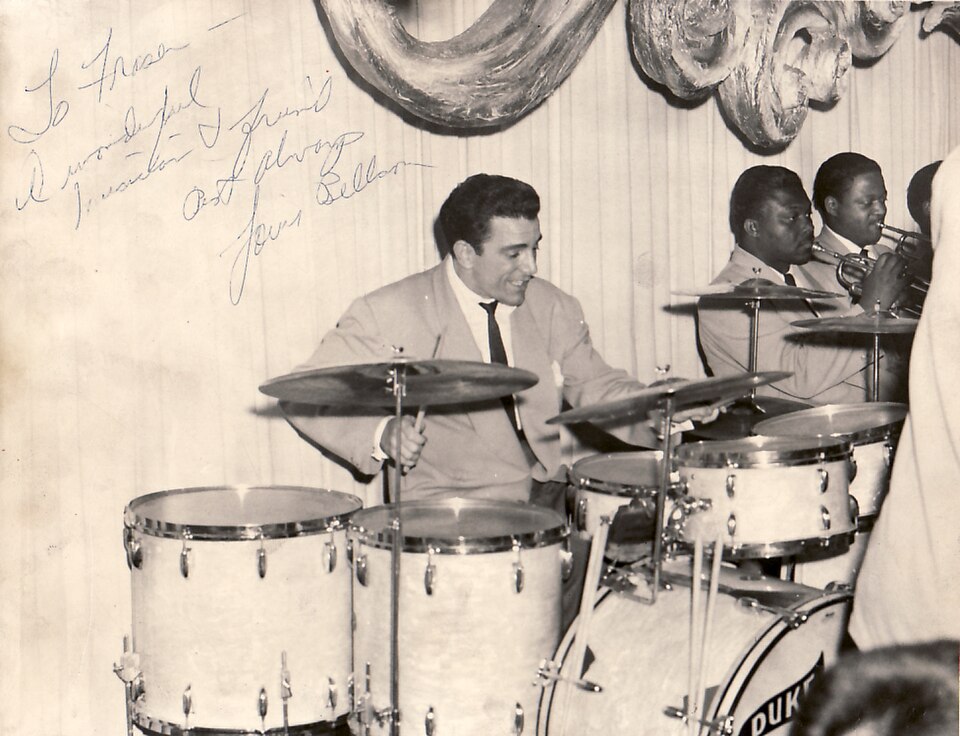
Louie Bellson (1924-2009)

Biography

Luigi Paulino Alfredo Francesco Antonio Balassoni, known as Louie Bellson, was born in Rock Falls, Illinois, and became one of jazz’s greatest drummers while leading his own big bands for over five decades. He played with Benny Goodman, Tommy Dorsey, Harry James, Duke Ellington, Count Basie, and his wife Pearl Bailey, among many others. Bellson invented the double bass drum setup and pioneered numerous drumming techniques. Beyond playing, he composed and arranged extensively for his own bands and others. His compositions including “Skin Deep” and “The Hawk Talks” became jazz standards. Bellson won numerous awards and continued performing until shortly before his death. His work demonstrated that drummer-leaders could create substantial musical arrangements, not just vehicles for drum solos. Bellson’s dedication to big band jazz helped keep the tradition vital through changing musical eras.

Musical Style

Bellson’s arranging style featured exciting drum showcases combined with sophisticated ensemble writing, maintaining big band traditions while incorporating modern elements. His arrangements demonstrated solid understanding of orchestration and formal structure, with excellent section writing and clear voicings. What distinguished Bellson’s work was his understanding of rhythm—as a master drummer, he wrote arrangements with particularly strong rhythmic foundations and dynamic pacing. His charts featured exciting builds, dramatic dynamics, and effective use of the entire band. Bellson’s voicings drew from swing tradition while incorporating bebop and contemporary harmonies. His arrangements balanced showcasing his drumming with featuring other soloists and creating interesting ensemble passages. Bellson’s style represented the continuation of swing-era big band tradition with contemporary updates, proving that drummer-leaders could be complete musicians.

Orchestration Techniques

Bellson’s orchestrations reflect his drummer’s perspective on ensemble dynamics, employing voicings that create rhythmic clarity and accent alignment between horns and rhythm section. His brass writing utilizes spread voicings with trombones providing rhythmic foundation on beats two and four while trumpets supply melodic material in their middle-high register, creating natural separation of function. Sectional writing emphasizes rhythmic unison between all sections during climactic passages, with the entire horn section functioning as one massive voice moving in parallel block chords. Contrapuntal techniques include sophisticated use of rhythmic counterpoint where different sections maintain independent rhythmic patterns that interlock with the drum patterns, creating composite grooves. Bellson’s register usage demonstrates awareness of dynamic balance, positioning horns in ranges where they can project through the rhythm section during ensemble passages without overwhelming during quieter solo features. His saxophone voicings typically employ four-way close with baritone doubling, creating a unified sectional sound that can punch through the full drum kit sound. Rhythmic notation is particularly detailed in Bellson’s scores, with specific sticking patterns suggested for the drum part and coordinated articulations in horn parts that align with snare and bass drum figures. Textural approaches favor the gradual build from sparse to full, with instruments entering systematically to create controlled crescendos that culminate in powerful tutti statements. Bellson’s preferred configuration is the standard big band with prominent drum set positioning, ensuring visual and aural focus on the rhythm section foundation. Dynamic architecture employs dramatic contrasts between whisper-quiet passages and thunderous climaxes, with careful attention to ensemble dynamics that allow drum features to integrate naturally rather than interrupting musical flow. His signature technique involves scoring brass accents that double drum accent patterns, creating moments where horns and drums strike together for maximum rhythmic impact, a technique that emerged from his understanding of how band sections can reinforce rather than compete with percussion.

Top Albums

Louie Bellson Big Band - “The Louie Bellson Explosion” (1975)

Bellson’s arrangements showcase his approach to contemporary big band writing. His charts feature strong swing feeling with modern touches and excellent dynamic contrasts. What makes these arrangements effective is their pacing—Bellson understood how to build excitement through arrangement, not just drumming. His composition “Ya Gotta Try” demonstrates his gift for creating memorable themes with exciting orchestral development. The voicings prove Bellson’s solid understanding of big band orchestration beyond his primary identity as drummer.

Louie Bellson - “Peaceful Thunder” (1998)

Bellson’s later arrangements show continued evolution and sophistication. His charts here balance his drumming features with substantial ensemble writing and interesting solo spaces for others. What’s particularly impressive is Bellson’s mature restraint—his arrangements serve the music rather than merely showcasing technique. His composition “Peaceful Thunder” demonstrates how apparent contradictions (peaceful/thunder) can be resolved through sophisticated arranging. The album represents Bellson’s mature synthesis of swing tradition and contemporary approaches.

Louie Bellson Big Band - “Airmail Special” (2001)

Bellson’s arrangements for this project demonstrate his continued vitality into his late 70s. His charts feature his signature combination of swing feeling, exciting dynamics, and solid ensemble writing. What makes these arrangements notable is their energy—Bellson maintained youthful enthusiasm while bringing decades of experience to bear. His arrangement of “Caravan” shows how familiar material can be refreshed through creative orchestration and dynamic pacing. The album proves Bellson remained committed to quality big band jazz throughout his long career.