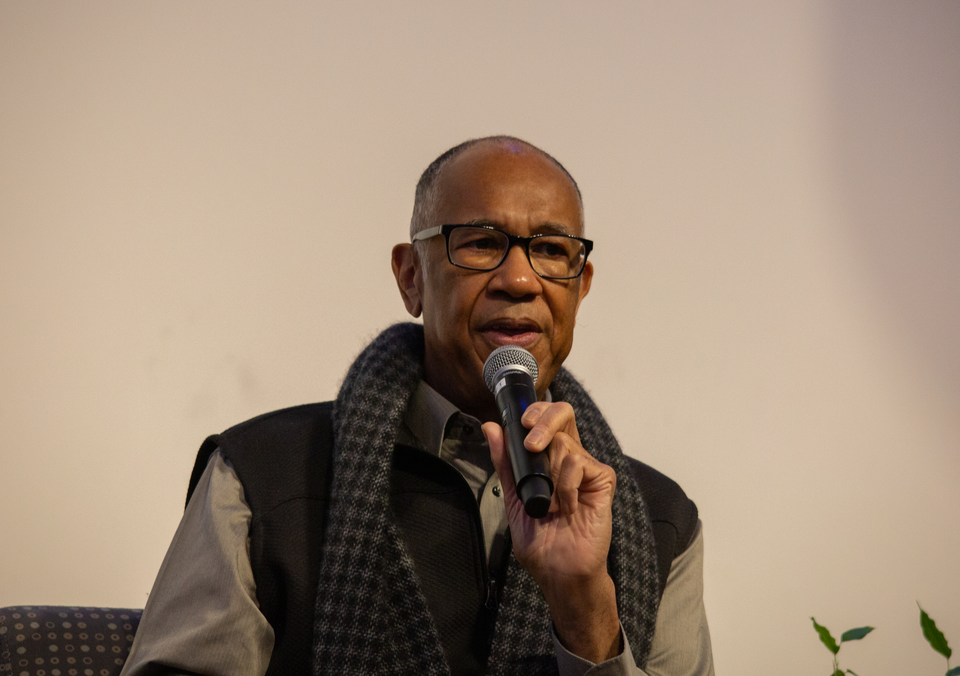
John Clayton (b. 1952)
Biography
John Lee Clayton Jr. was born in Venice, California, into a musical family and studied bass at Indiana University. He’s an acclaimed bassist, composer, and arranger who has worked with Count Basie, Quincy Jones, Monty Alexander, and countless others. Clayton co-leads the Clayton-Hamilton Jazz Orchestra with his brother Jeff Clayton (saxophonist) and drummer Jeff Hamilton, serving as principal arranger. The CHJO has earned multiple Grammy nominations and critical acclaim. Clayton has also served as artistic director for various jazz programs and festivals. His arrangements are performed by orchestras and big bands worldwide. Clayton’s work balances tradition and modernity with remarkable skill, demonstrating complete mastery of both bass playing and big band writing. His success shows that bassists can be complete musician-arrangers, not merely rhythm section members.
Musical Style
Clayton’s arranging style balances tradition and modernity, featuring sophisticated voicings, strong swing feeling, and excellent orchestration rooted in big band heritage while incorporating contemporary elements. His arrangements demonstrate complete technical mastery with careful attention to voice leading, sectional balance, and formal structure. What distinguishes Clayton’s work is its warmth and swing—his charts are sophisticated yet never cold or academic, always maintaining strong rhythmic drive and emotional connection. His voicings are rich and colorful, drawing from Basie, Ellington, and contemporary influences. Clayton writes beautifully for all sections, showing deep understanding of each instrument’s capabilities. His arrangements balance composition and improvisation perfectly, featuring soloists within well-crafted ensemble frameworks. Clayton’s style represents contemporary big band arranging that honors tradition while sounding fresh and vital.
Orchestration Techniques
Clayton’s orchestrations blend Basie economy with Ellington tonal sophistication, employing predominantly drop-2 and drop-3 voicings that create fullness while maintaining the clarity essential for swinging rhythm section interaction. His brass writing utilizes strategic doublings between trumpets and trombones at the octave or unison, creating power without the thickness of close-voiced clusters. Sectional writing demonstrates mastery of concerted ensemble techniques, with all sections moving together in rhythmic unison while maintaining voice independence through careful contrary motion in inner parts. Contrapuntal techniques include sophisticated use of pedal tones in bass trombone while upper brass and saxophones maintain moving harmonic material above, creating harmonic anchoring with melodic interest. Clayton’s register usage reflects his experience as a bassist, ensuring that the bass voice (whether written for bass trombone or baritone saxophone) provides solid harmonic foundation without doubling the string bass’s melodic function. His saxophone voicings emphasize blend and warmth, typically scoring the lead alto in its lyrical middle register with supportive inner voices carefully spaced to avoid clouding the harmonic picture. Rhythmic notation includes precise swing articulations with attention to phrase endings and pickup note weights that define the West Coast swing feel. Textural approaches favor the medium density characteristic of the best swing arranging, avoiding both excessive transparency and cluttered thickness. Clayton’s preferred configuration is the standard seventeen-piece big band with emphasis on the rhythm section’s prominence, reflecting his understanding of the bass-drums-piano interaction as the foundation for all ensemble writing. Dynamic architecture employs gradual builds coordinated with orchestrational density, adding instruments and voices to create crescendos rather than relying solely on volume increases. His signature technique involves orchestrating bass lines that double the written bass part in strategic moments, using low brass or baritone saxophone to reinforce rhythmic figures and create impact on downbeats and phrase endings.
Top Albums
Clayton-Hamilton Jazz Orchestra - “Groove Shop” (1990)
Clayton’s arrangements for the CHJO’s debut album showcase his distinctive voice. His charts feature sophisticated voicings with strong swing feeling and excellent section writing. What makes these arrangements notable is their perfect balance—Clayton writes complex music that nonetheless grooves hard and communicates directly. His composition “Blues for Stephanie” demonstrates his gift for creating memorable melodies with sophisticated harmonic settings. The voicings prove Clayton’s complete mastery of big band orchestration and his understanding of West Coast big band tradition.
Clayton-Hamilton Jazz Orchestra - “Heart and Soul” (2001)
Clayton’s arrangements here demonstrate continued evolution and refinement. His charts maintain strong swing foundations while incorporating more contemporary harmonic and rhythmic elements. What’s particularly impressive is Clayton’s writing for soloists—his arrangements enhance improvisation through sophisticated yet supportive backgrounds. His arrangement of “Moanin’” shows how familiar material can be completely reimagined through creative orchestration. The album received Grammy nomination and represents the CHJO at peak form.
Clayton-Hamilton Jazz Orchestra - “The Clayton-Hamilton Jazz Orchestra featuring Jeff Hamilton” (2013)
Clayton’s later arrangements show mature synthesis of influences. His charts feature his signature combination of sophistication and swing, with excellent orchestration and strong musical substance. What makes these arrangements fascinating is their completeness—Clayton achieves perfect balance between all elements (composition, orchestration, solo space, swing feeling). His composition “New Orleans” demonstrates his continued melodic gifts and his understanding of how to create exciting, multi-layered big band arrangements. The album proves Clayton’s sustained excellence as arranger-composer-bassist.