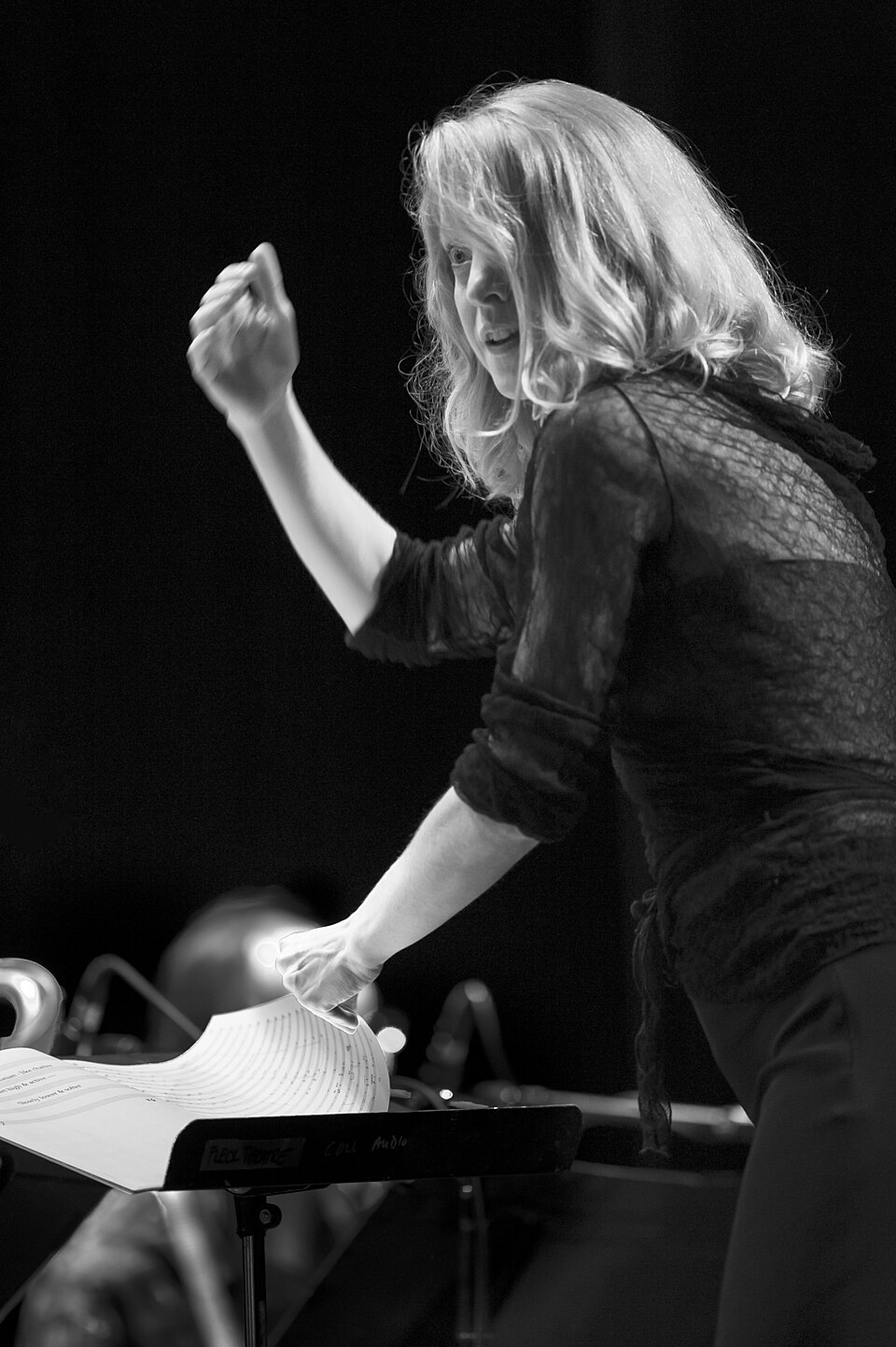
Portrait of Maria Schneider
Marek Lazarski, Toronto Jazz Festival 2009, via Wikimedia Commons · CC BY-SA 4.0

Maria Schneider (b. 1960)

Biography

Maria Lynn Schneider was born in Windom, Minnesota, and studied at the University of Minnesota, Eastman School of Music, and University of Miami. She studied privately with Bob Brookmeyer and worked as Gil Evans’s assistant, absorbing his orchestral concepts. Since 1992, Schneider has led her own orchestra, creating some of contemporary jazz’s most acclaimed arrangements. She’s won multiple Grammy Awards and pioneered artist-funded internet distribution. Schneider’s commissions include works for major orchestras and jazz ensembles worldwide. Her advocacy for musicians’ rights and fair compensation has been influential. Schneider’s arrangements represent the contemporary pinnacle of large ensemble jazz writing, demonstrating that the big band tradition remains vital and capable of fresh expression. Her success has inspired countless younger arrangers and proved that serious, uncompromising music can find audiences.

Musical Style

Schneider’s arranging style features cinematic scope, sophisticated orchestration, and extraordinary attention to instrumental color and texture. Her arrangements tell stories through purely instrumental means, creating vivid musical narratives. What distinguishes Schneider’s work is her complete mastery of orchestral resources combined with genuine emotional depth—her music is both intellectually sophisticated and deeply moving. Her voicings are carefully crafted, often featuring subtle inner voice movement and unexpected instrumental combinations that create unique colors. Schneider writes beautifully for wind instruments, understanding their individual characteristics and blending capabilities. Her harmonic language draws from jazz tradition while incorporating contemporary classical influences, creating rich, complex textures. Schneider’s arrangements balance written complexity with improvisational freedom, featuring soloists within carefully constructed orchestral frameworks. Her style represents the fulfillment of Gil Evans’s orchestral vision for contemporary times.
Orchestration Techniques

Schneider’s orchestrations demonstrate mastery of instrumental color through innovative combinations, frequently pairing instruments from different families (accordion with flugelhorn, bass clarinet with French horn) to create composite timbres unavailable through traditional doublings. Her voicing approach employs open structures with wide intervals between voices, often leaving gaps in the chord’s vertical structure that create transparency and allow individual lines to remain audible within dense textures. Sectional writing transcends traditional jazz big band paradigms, treating the ensemble as a true orchestra where woodwind doubles (clarinet, flute, alto flute) function as independent voices rather than mere coloristic additions. Contrapuntal techniques include elaborate polyphonic passages where multiple melodic lines weave through the texture, each maintaining rhythmic independence while creating harmonic convergence at cadential points. Schneider’s register usage is particularly sophisticated, exploiting extreme registers for expressive effect: bass clarinet pedal tones, flugelhorn in its warm middle register, and flute in its breathy lower octave. Her brass writing favors soft dynamics and muted colors, with extensive use of Harmon mutes, cup mutes, and bucket mutes to achieve blend with woodwinds and create chamber-like intimacy within the large ensemble. Rhythmic notation includes complex rubato passages with fermatas and breath marks that encourage orchestral flexibility, alongside precisely notated metric modulations that create cinematic temporal effects. Textural approaches favor pointillistic passages where individual instrumental colors emerge from silence, creating kaleidoscopic effects through rapid timbral shifts. Schneider’s preferred configuration expands the traditional big band with added woodwind doubles and acoustic guitar, creating an ensemble capable of both jazz improvisation and orchestral tone painting. Dynamic architecture employs extended crescendos and diminuendos that unfold over many measures, creating wave-like formal structures that build and recede organically. Her signature technique involves using sustained cluster chords that gradually evolve through individual voice movement, with each note of the cluster changing one at a time to create harmonic transformation without traditional chord progression, a technique derived from her study with Gil Evans adapted for even greater subtlety.

Top Albums

Maria Schneider Orchestra - “Evanescence” (1994)

Schneider’s debut album showcases her distinctive voice already fully formed. Her arrangements feature sophisticated orchestration with cinematic sweep and careful attention to dynamics and color. What makes these charts remarkable is their maturity—Schneider demonstrated complete mastery of large ensemble writing from the beginning. Her composition “Evanescence” creates vivid musical imagery through purely orchestral means, demonstrating her gift for musical storytelling. The voicings reveal her study with Evans while establishing her own voice.

Maria Schneider Orchestra - “Concert in the Garden” (2004)

Schneider’s Grammy-winning masterpiece represents the peak of contemporary big band arranging. Her charts create rich, complex musical worlds while maintaining emotional directness. What’s particularly impressive is Schneider’s success at extended form—these aren’t simply blowing vehicles but coherent compositions that sustain interest through development and contrast. Her “Bulería, Soleá y Rumba” demonstrates her ability to incorporate world music influences while maintaining jazz essence. The album proves that big band jazz could still produce profound artistic statements in the 21st century.

Maria Schneider Orchestra - “The Thompson Fields” (2015)

Schneider’s arrangements exploring childhood memories in rural Minnesota demonstrate her continued evolution. Her charts here feature even greater orchestral sophistication and emotional depth. What makes these arrangements fascinating is their combination of specificity and universality—Schneider evokes particular places and memories yet creates music with broader resonance. Her “The Monarch and the Milkweed” addresses environmental themes through musical means, showing how arrangements can engage contemporary issues. The album won Grammy and shows Schneider at peak creative powers.

Pieces & Ensembles

Hang Gliding — Allégresse (2000)

Trumpets Tpt Tpt Tpt Tpt Tpt
Trombones & Low Brass Tbn Tbn Tbn BTb
Saxes & Woodwinds SS AS TS TS BS AS
Rhythm Section Pno Gtr Bass Dr Perc
Faded seats are standard big band chairs this piece doesn't use.

Five reed chairs double soprano, clarinets, flutes, oboe, and English horn; five trumpets all double flugelhorn — Ingrid Jensen takes the famous flugelhorn solo.

Concert in the Garden — Concert in the Garden (2004)

Trumpets Tpt Tpt Tpt Tpt
Trombones & Low Brass Tbn Tbn Tbn BTb
Saxes & Woodwinds AS AS TS TS BS
Rhythm Section Pno Acc Gtr Bass Dr Vox

Gary Versace's accordion and Luciana Souza's wordless voice color the standard sections — the album that won Schneider her first Grammy.

Data Lords — Data Lords (2020)

Trumpets Tpt Tpt Tpt Tpt
Trombones & Low Brass Tbn Tbn Tbn BTb
Saxes & Woodwinds AS AS TS TS BS
Rhythm Section Pno Acc Gtr Bass Dr

Ben Monder's guitar and Gary Versace's accordion are central to the dark title track; the baritone chair also covers bass and contrabass clarinets.

Listen