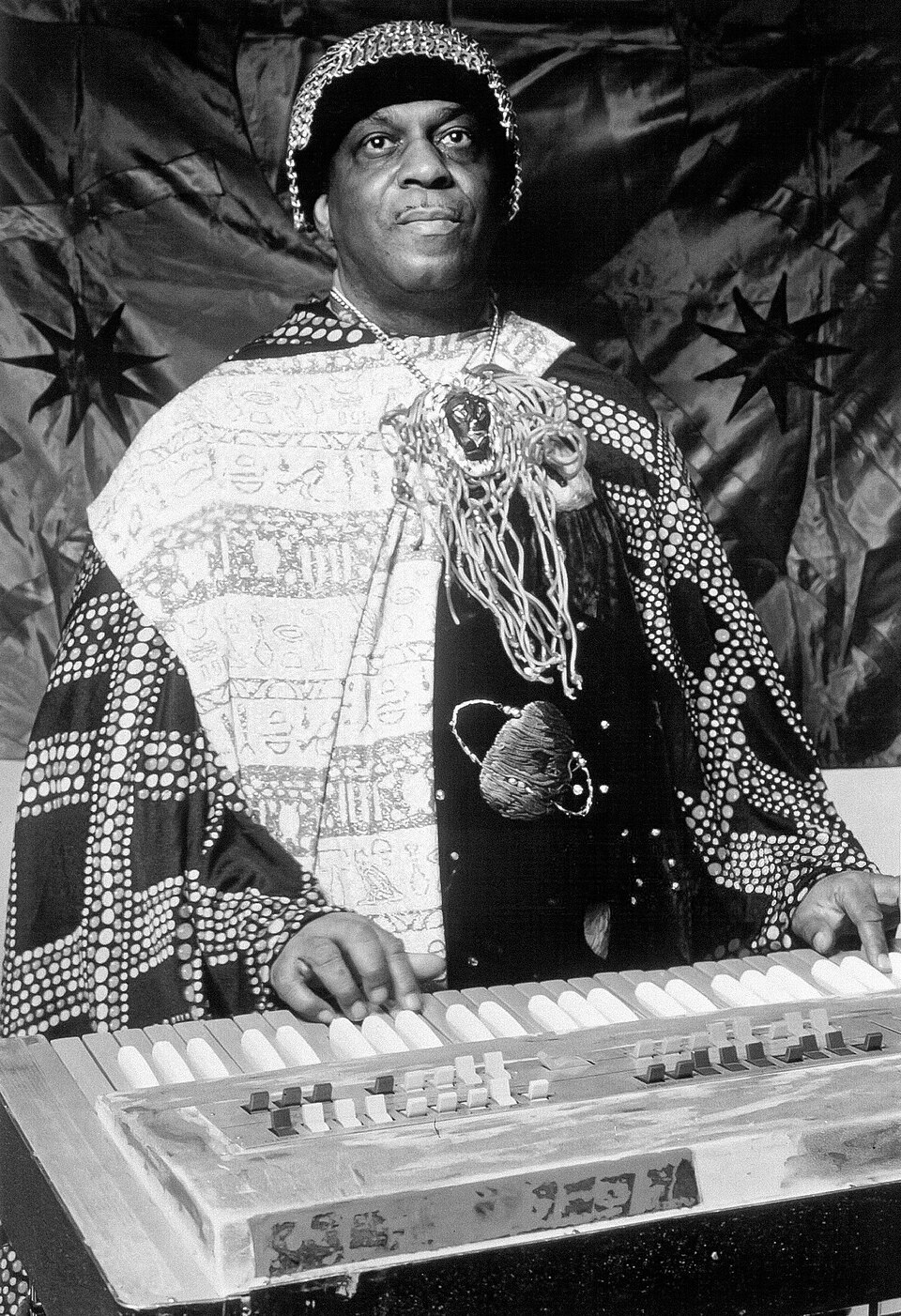
Sun Ra (1914-1993)

Biography

Herman Poole Blount was born in Birmingham, Alabama, and claimed to be from Saturn. He adopted the name Sun Ra and led his Arkestra from the 1950s until his death. Ra’s music evolved from swing-influenced jazz to cosmic avant-garde incorporating electronics, free improvisation, and elaborate theatrical elements. He composed hundreds of pieces and arranged for ensembles from small groups to big bands. Ra influenced free jazz, Afrofuturism, and experimental music broadly. Despite his eccentricity, Ra was a serious musician and bandleader who maintained a working orchestra for four decades.

Musical Style

Sun Ra’s arranging style was utterly unique, combining swing era big band traditions with free jazz, electronics, and cosmic philosophy. His arrangements ranged from Fletcher Henderson-style swing to completely free collective improvisation. Ra incorporated unusual instruments (electric keyboards, space-age electronics), theatrical elements, and chanting into his arrangements. His style emphasized timbral exploration and collective improvisation within loose structures. Ra’s arrangements often featured sudden shifts between composed passages and free sections. His voicings drew on swing era models but incorporated dissonances and unusual doublings. Ra’s work was simultaneously archaic and futuristic, traditional and revolutionary. His arranging concepts influenced avant-garde and experimental music significantly.

Orchestration Techniques

Sun Ra’s orchestration techniques represent a radical fusion of Fletcher Henderson-era big band principles with avant-garde timbral exploration, creating scores that function as frameworks for controlled chaos rather than fixed musical texts. His voicings deliberately juxtapose consonant swing-era harmonies with dense chromatic clusters, often scoring the brass section in close-position dissonant voicings while saxophones play traditional riff-based figures, creating bitonal textures that sound both archaic and futuristic simultaneously. Ra employs extended techniques throughout his orchestrations: multiphonics in the saxophone section, brass instruments played through mutes with vocal growls, and percussion instruments prepared with various objects to alter their timbres. The integration of electronic keyboards—Clavioline, Farfisa organ, early synthesizers—into big band contexts was pioneering, with Ra using these instruments for both sustained drones and percussive attacks that blend with acoustic instruments. His sectional writing alternates between tightly arranged passages in rhythmic unison, where all instruments articulate Fletcher Henderson-style swing figures, and graphic notation sections where musicians are given only general directions for collective improvisation. Ra’s contrapuntal approach often involves polytonal layering where different sections of the Arkestra operate in different keys simultaneously, creating dense harmonic webs that resolve unexpectedly or not at all. His use of space as structural element is notable: sudden silences interrupt dense passages, creating dramatic pauses that serve philosophical as much as musical purposes. Rhythmic notation in Ra’s scores ranges from precisely notated swing patterns to completely free sections indicated only by duration, with musicians expected to understand when to adhere to tradition and when to abandon it. Ra’s dynamic architecture features extreme contrasts—subito shifts from fortissimo tutti passages to solo electronic keyboard whispers—creating psychological rather than purely musical effects. Instrumental combinations in his arrangements include unconventional doublings: bass clarinet with tuba in unison for growling bass lines, piccolo with electronic organ in extreme upper register, and entire percussion section including unconventional instruments like space gongs and thunder sheets. A signature technique involves scoring chanting and vocal interjections—often in invented languages or repetitive mantras—that overlap with instrumental passages, adding textural layers that transcend traditional jazz orchestration. Ra’s treatment of the rhythm section exploits multiple drummers and percussionists playing interlocking polyrhythmic patterns derived from African and Afro-Cuban sources, creating dense rhythmic textures over which horn sections superimpose composed or improvised figures. His approach to form deliberately avoids Western structural conventions, with compositions sometimes continuing indefinitely or stopping abruptly without resolution, reflecting his cosmic philosophy through musical structure.

Top Albums

Sun Ra Arkestra - “The Heliocentric Worlds of Sun Ra, Volumes 1 & 2” (1965)

Ra’s arrangements here represent his free jazz period. The charts feature loose structures allowing collective improvisation alongside composed passages. What makes these arrangements remarkable is their balance between order and chaos—Ra provides enough structure to create coherence while allowing maximum freedom. The timbral palette is unlike any other jazz, incorporating prepared instruments and electronics. These recordings influenced free jazz and experimental music widely.

Sun Ra Arkestra - “Lanquidity” (1978)

Ra’s later arrangements incorporate funk, electronics, and cosmic themes. The charts feature extended compositions with multiple sections and moods. What’s particularly notable is how Ra fuses seemingly incompatible elements—funk grooves, free improvisation, electronic textures—into coherent statements. The arrangements demonstrate Ra’s continued evolution and undiminished creativity. This work influenced electronic jazz and fusion.

Sun Ra Arkestra - “Swinging the Trane” (1987)

Ra’s arrangements of Coltrane compositions demonstrate his ability to work with others’ material while maintaining his voice. The charts honor Coltrane while transforming compositions through Ra’s unique lens. What makes these arrangements fascinating is hearing Ra’s cosmic approach applied to Coltrane’s spiritual jazz. The work demonstrates that Ra could arrange in various contexts while maintaining his identity.