J.J. Johnson (1924-2001)
Biography
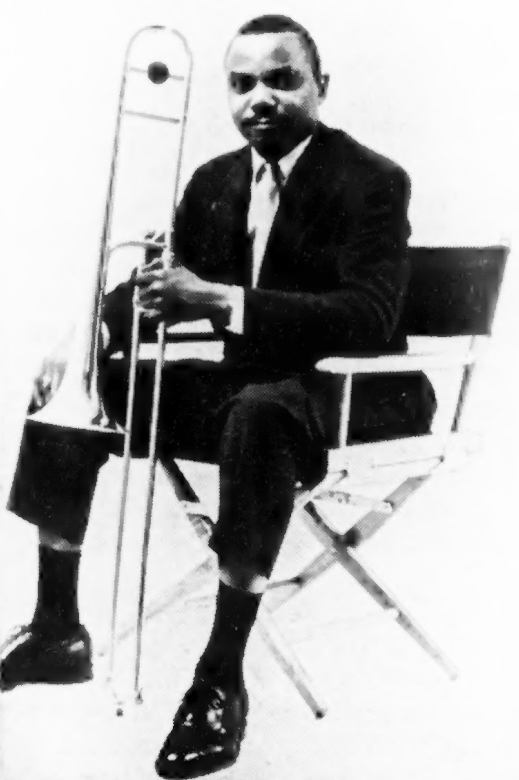
James Louis “J.J.” Johnson was born in Indianapolis and revolutionized jazz trombone while establishing himself as an important composer and arranger. He played with Benny Carter, Count Basie, and others before becoming a pioneering bebop trombonist. Johnson co-led groups with Kai Winding and led his own quintets and sextets throughout the 1950s and 1960s. His compositions including “Lament,” “Wee Dot,” and “Enigma” became jazz standards. In the 1970s, Johnson moved increasingly toward film and television scoring while continuing to perform occasionally. His arranging work featured bebop sophistication with excellent brass writing and logical structural development. Johnson received numerous awards and remained active until the 1990s. His influence on jazz trombone was definitive—he proved the instrument could execute bebop lines with the same facility as saxophone or trumpet, while his arranging demonstrated technical excellence combined with emotional depth.
Musical Style
Johnson’s arranging style combined bebop harmonic sophistication with structural clarity and excellent brass voicings. His arrangements featured strong melodic content with complex yet logical harmonic movement. As a brass player, Johnson understood sectional balance and blend intimately, creating voicings that were both full and transparent. His charts often featured intricate unison lines and counterpoint that showcased his compositional skills. What distinguished Johnson’s arranging was its combination of technical demands and musical naturalness—his arrangements were challenging yet always seemed logical and inevitable. Johnson wrote for soloists intelligently, providing interesting backgrounds that enhanced without overwhelming. His style represented bebop principles applied to arrangement: sophisticated harmonies, angular melodies, and rhythmic complexity all organized within clear structures. Johnson’s work proved that intellectual rigor and emotional warmth weren’t contradictory.
Orchestration Techniques
Johnson’s orchestration techniques reflect his intimate understanding of brass instruments, particularly the trombone, resulting in voicings and sectional writing that exploit the unique characteristics of brass ensemble sonority. His approach to brass voicings employs close-position structures in the middle to upper register where trombones and trumpets blend most effectively, typically using four-part harmonization with trumpets on top two voices and trombones on lower two, creating a cohesive brass choir sound. Johnson’s writing for multiple trombones demonstrates exceptional understanding of how to maintain clarity in lower registers: he avoids thick voicings below middle C, instead using wider intervals—perfect fourths and fifths—that allow each voice to sound distinctly. His contrapuntal technique involves creating bebop-influenced melodic lines that function as counterpoint against the main theme, with these counter-lines exhibiting the same chromatic sophistication and rhythmic complexity as improvised bebop solos. Johnson employs voice leading principles borrowed from classical harmony, with careful attention to avoiding parallel fifths and octaves while navigating complex chromatic progressions, giving his arrangements a sense of inevitability and logic. The sectional writing in his charts features brass soli passages where multiple horns execute intricate unison lines that would challenge single instruments, exploiting the power of ensemble unison to achieve precision impossible for solo players. His use of pedal tones typically involves the bass trombone or tuba sustaining the root while upper brass voices move through chromatic substitutions, creating harmonic tension that resolves satisfyingly. Johnson’s rhythmic notation is precise in articulating bebop phrasing, with specific accent marks indicating the characteristic placement of emphasis on weak beats and upbeat anticipations that define the style. His dynamic architecture in small group arrangements uses terraced dynamics where the ensemble shifts between piano and forte passages rather than gradual changes, creating structural clarity that mirrors bebop’s emphasis on contrast. Johnson’s treatment of backgrounds behind improvising soloists involves sustained pad voicings using brass choir in their warmest middle register, with occasional rhythmic punctuations that outline the harmonic rhythm without interfering with the soloist’s lines. Instrumental doublings in his arrangements often pair trumpet with alto saxophone an octave apart for melodic statements, exploiting the brightness of both instruments while creating octave reinforcement. A signature technique involves writing chromatic approach patterns for the brass section that outline tritone substitutions and other bebop harmonic devices, making the harmonic sophistication audible through melodic movement rather than just vertical chord structures. Johnson’s approach to extended forms, as demonstrated in his “Perceptions” suite, involves thematic development procedures borrowed from classical composition—motivic fragmentation, inversion, and sequence—applied to jazz materials with orchestral forces, showing that bebop compositional thinking could sustain large-scale structures.
Top Albums
J.J. Johnson - “The Eminent Jay Jay Johnson, Vol. 1 & 2” (1953-1955)
Johnson’s arrangements for his own quintets and sextets showcase his bebop writing at its finest. His charts feature sophisticated harmonies with strong melodic content and excellent brass writing. What makes these arrangements notable is their perfect balance between composition and improvisation—Johnson provides substantial written material while leaving room for extended solos. His arrangement of “It Could Happen to You” demonstrates his gift for reharmonization and melodic development. The voicings prove Johnson’s understanding of small group dynamics and his ability to create full sounds with limited instrumentation.
J.J. Johnson - “J Is for Jazz” (1956)
Johnson’s arrangements for sextet with two trombones (himself and Kai Winding) demonstrate his mastery of brass writing. His charts exploit the trombone blend while creating clear, swinging ensemble passages. What’s particularly impressive is how Johnson writes for two trombones without creating muddiness—his voicings maintain clarity even in the lower register. His composition “Blues” showcases his ability to create interesting arrangements from simple materials, with sophisticated harmonies emerging from blues foundations. The album represents Johnson’s arranging at peak form.
J.J. Johnson - “Perceptions” (1961)
Johnson’s six-movement suite for jazz orchestra and Dizzy Gillespie demonstrates his ambitions as composer-arranger. His writing integrates large orchestra with jazz soloists, creating extended forms that sustain interest through thematic development and varied orchestration. What makes this work remarkable is Johnson’s success at extended form—the movements connect coherently while providing contrast. His orchestration is sophisticated, using the full palette of symphonic resources while maintaining jazz feeling. The suite proves that Johnson could work at large scale while maintaining the spontaneity and swing essential to jazz.