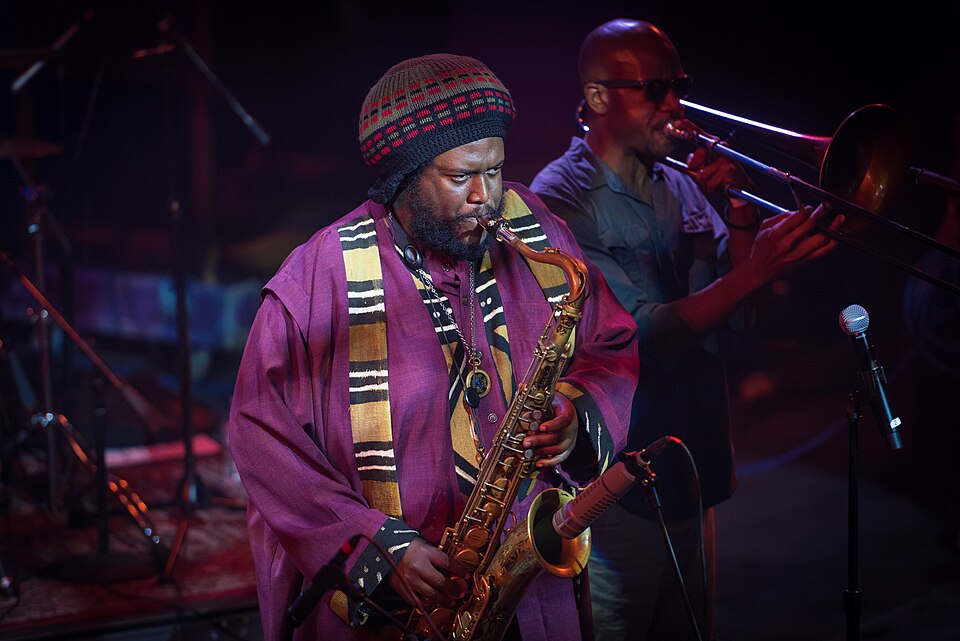
Kamasi Washington (b. 1981)
Biography
Kamasi Washington was born in Los Angeles and became a saxophonist, composer, and bandleader who revitalized large ensemble jazz for contemporary audiences. He studied ethnomusicology at UCLA before establishing himself in Los Angeles’s jazz scene. Washington gained widespread attention through work with Kendrick Lamar before releasing “The Epic” (2015), a triple album that brought jazz to new audiences. His arrangements feature orchestral scope with strings, choir, and extended forms incorporating jazz, funk, soul, and hip-hop. Washington combines spiritual jazz traditions (Coltrane, Sanders) with contemporary production. His success demonstrates that ambitious, uncompromising jazz can reach mainstream audiences when executed powerfully. Washington represents contemporary jazz reaching new generations through bold artistic statements honoring history while embracing current sounds.
Musical Style
Washington’s arranging style features orchestral scope combining spiritual jazz traditions with contemporary production, incorporating strings, choir, and extended forms. His arrangements demonstrate ambition and scale rare in contemporary jazz. What distinguishes Washington’s work is its combination of traditional jazz values and contemporary presentation—his music honors Coltrane and Sanders while sounding completely current. His voicings are lush and powerful, creating wall-of-sound textures. Washington’s style represents contemporary spiritual jazz: ambitious, uncompromising, and connecting with diverse audiences.
Orchestration Techniques
Washington employs massive voicing structures that combine full string orchestra with traditional jazz big band and choir, creating wall-of-sound textures where multiple sections double melodic material in parallel octaves for maximum sonic impact. His sectional writing features strings providing sustained harmonic pads in divisi voicings (often six-part string choir: two violin sections, violas, cellos, and basses) while brass delivers melodic statements derived from spiritual jazz traditions. Tutti passages employ full orchestral resources in rhythmic unison, creating overwhelmingly dense textures reminiscent of late Coltrane ensembles but amplified through orchestral means. Instrumental combinations feature unconventional doublings: wordless choir doubling saxophone melody lines, strings providing modal ostinato patterns derived from McCoy Tyner-style piano voicings, and multiple percussion instruments (kit drums plus hand percussion plus tympani) creating polyrhythmic foundations. Contrapuntal techniques include modal counterpoint where independent melodic lines move within pentatonic or modal frameworks (particularly favoring Dorian and Mixolydian modes), creating harmonic thickness through melodic superimposition rather than vertical chord stacking. Register exploitation spans extreme ranges: bass choir and cellos providing low-frequency foundation, multiple saxophone voices (tenor, alto, soprano) carrying melody in middle registers, and high strings plus soprano voices providing shimmering upper-register harmonic extensions. Rhythmic devices derive from funk and Afro-beat traditions, with bass patterns employing syncopated ostinatos, drums maintaining steady pocket grooves with sixteenth-note hi-hat patterns, and horns entering on rhythmically displaced points creating tension against the groove. Textural approaches favor density and saturation: arrangements pile multiple instrumental layers creating immersive sonic environments where individual timbres blend into composite textures rather than maintaining separate identities. His preferred configuration is the expanded jazz orchestra featuring full rhythm section (piano, bass, drums, percussion), big band brass and woodwinds (three to four trumpets, three trombones, five saxophones), full string section (twelve or more players), and choir (eight to twelve voices), totaling thirty-five to forty musicians. Dynamic architecture employs extended developmental arcs spanning twenty to thirty-minute movements, with gradual cumulative builds where instrumental layers enter progressively over long time spans, creating orchestral crescendos that peak in full ensemble fortissimo passages of overwhelming power. Signature techniques include his use of “spiritual repetition” where melodic and harmonic material repeats with slight variations creating hypnotic, trance-inducing effects derived from spiritual jazz traditions, and employment of choir vocalizations (wordless syllables: “ahs” and “ohs”) providing harmonic support that bridges gap between instrumental and vocal expression, creating uniquely devotional sonic environment.
Top Albums
Kamasi Washington - “The Epic” (2015)
Washington’s breakthrough triple album features his ambitious arrangements for large ensemble including strings and choir. His charts create extended, suite-like structures with powerful spiritual energy. What makes these arrangements remarkable is their success at sustaining interest over long forms through sheer musical power. His composition “The Magnificent 7” demonstrates his gift for creating memorable themes with sophisticated development. The album brought jazz to new audiences and established Washington as major voice.
Kamasi Washington - “Heaven and Earth” (2018)
Washington’s follow-up double album demonstrates sustained ambition. His arrangements maintain orchestral scope while exploring diverse moods and approaches. What’s particularly impressive is Washington’s range—these arrangements span from contemplative beauty to explosive energy. His work proves that ambitious jazz can maintain audience engagement through consistent quality and powerful vision.
Cultural Impact
Washington’s work reaching beyond traditional jazz audiences demonstrates contemporary jazz’s potential for broader impact. His success shows that uncompromising artistic statements can find audiences when executed with conviction and quality. This represents hope for jazz’s future, proving the music remains vital for new generations when presented powerfully.