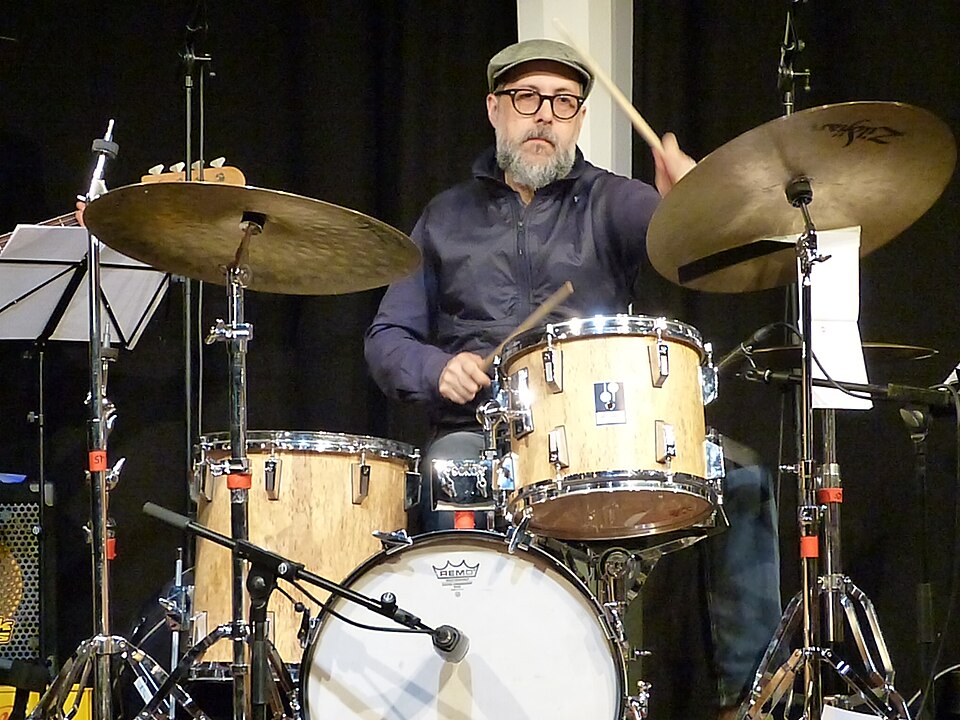
John Hollenbeck (b. 1968)
Biography
John Hollenbeck was born in Binghamton, New York, and became one of contemporary music’s most innovative composer-arrangers. He studied at the Eastman School of Music and has worked with diverse artists from Bob Brookmeyer to Meredith Monk. Hollenbeck leads the Claudia Quintet and the John Hollenbeck Large Ensemble, creating some of contemporary music’s most acclaimed work. His compositions and arrangements blur boundaries between jazz, classical, and world music. Hollenbeck has won Grammy Awards and received numerous commissions from major orchestras and jazz ensembles. He teaches at McGill University. His work demonstrates that contemporary creative music continues evolving, finding fresh approaches to improvisation, composition, and arrangement. Hollenbeck represents the generation of musicians equally comfortable in jazz and contemporary classical contexts, creating personal syntheses that transcend genre categories.
Musical Style
Hollenbeck’s arranging style features sophisticated contemporary approaches combining jazz improvisation, classical compositional techniques, and world music influences, with emphasis on timbre, texture, and rhythmic complexity. His arrangements demonstrate complete mastery of both jazz and contemporary classical idioms. What distinguishes Hollenbeck’s work is its emphasis on sound itself—his music explores orchestral color and texture as primary compositional elements. His voicings are adventurous and unique, often featuring unusual instrumental combinations and extended techniques. Hollenbeck’s rhythmic language is complex yet organic, incorporating influences from Steve Reich, African music, and jazz. His arrangements balance written material and improvisation in innovative ways, creating frameworks that inspire creative interaction. Hollenbeck’s style represents contemporary creative music: intellectually rigorous, sonically adventurous, and emotionally engaged.
Orchestration Techniques
Hollenbeck’s orchestration draws heavily from spectral composition techniques, constructing voicings based on overtone series relationships rather than traditional tertian or quartal harmony, resulting in sonorities that emphasize timbre as a primary structural element. His sectional writing incorporates interlocking rhythmic patterns influenced by minimalism and African polyrhythm, where brass, woodwinds, and rhythm section maintain independent metric cycles that periodically align to create phasing effects. Instrumental combinations are highly unconventional: he pairs accordion with vibraphone for ethereal sustain, uses muted brass in close intervals against metallic percussion timbres, or combines extended woodwind techniques (multiphonics, key clicks, flutter tonguing) with prepared piano sounds. Contrapuntal approaches include isorhythmic structures where melodic and rhythmic patterns operate on different cycle lengths, creating complex polyphonic textures that unfold gradually over extended time spans. Register exploitation is strategic and often extreme, juxtaposing instruments at the furthest edges of their ranges to create dramatic timbral contrast: bass clarinet in its lowest chalumeau register against piccolo trumpet, or contrabass trombone pedal tones supporting high soprano saxophone altissimo passages. Rhythmic notation is meticulous and complex, employing metric modulation, nested tuplets, and polymetric superimposition with extreme precision, requiring performers to execute rhythmically intricate passages while maintaining groove-based feel. Textural approaches range from pointillistic chamber-like passages to dense orchestral clusters, often within single compositions, with smooth transitions achieved through orchestrational sleight-of-hand. His ensemble configurations frequently include non-traditional jazz instruments: accordion, vibraphone, and guitar in his Claudia Quintet, or expanded percussion sections in his large ensemble work. Dynamic architecture follows long-form developmental arcs inspired by classical symphonic structures, with dynamics serving structural rather than merely expressive purposes.
Top Albums
John Hollenbeck Large Ensemble - “Eternal Interlude” (2009)
Hollenbeck’s arrangements for his large ensemble showcase his unique approach to contemporary jazz orchestration. His charts feature sophisticated rhythmic structures, inventive timbral combinations, and careful formal development. What makes these arrangements remarkable is their combination of complexity and coherence—Hollenbeck writes challenging music that nonetheless creates unified musical experiences. His composition “Elf” demonstrates his gift for creating intricate rhythmic structures that groove despite their complexity. The album won wide acclaim and represents peak contemporary creative music.
John Hollenbeck Large Ensemble - “All Can Work” (2018)
Hollenbeck’s arrangements here demonstrate continued evolution and ambition. His charts incorporate political commentary through musical means, addressing contemporary issues while maintaining artistic substance. What’s particularly impressive is Hollenbeck’s integration of concept and craft—his music serves ideas without sacrificing musical quality. His setting of Pete Seeger’s “All Mixed Up” shows how social content and musical sophistication can coexist. The album demonstrates Hollenbeck’s maturity as composer-arranger addressing the world through music.
Claudia Quintet - various albums
Hollenbeck’s arrangements for his quintet (accordion, vibraphone, guitar, bass, drums) demonstrate his gifts in smaller contexts. His charts exploit the unique timbral possibilities of this unusual instrumentation, creating music that’s chamber-like yet grooves. What makes these arrangements fascinating is their exploration of color—Hollenbeck creates rich sonic worlds with limited resources. His compositions for this group prove that innovation comes from creative thinking rather than large forces. The work represents Hollenbeck’s versatility across ensemble sizes.