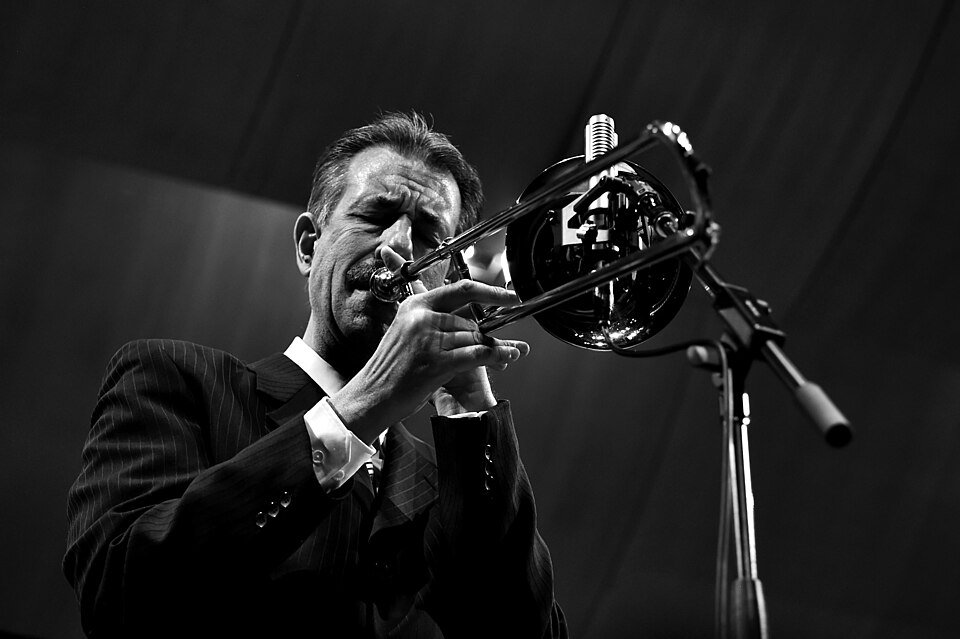
John Fedchock (b. 1957)
Biography
John Fedchock was born in Cleveland, Ohio, and became an acclaimed trombonist and arranger. He studied at Ohio State University before playing with Woody Herman’s Orchestra, Gerry Mulligan, and Louie Bellson. Since 1992, Fedchock has led his own New York Big Band, which has earned multiple Grammy nominations. His arrangements are performed by professional and student ensembles worldwide. Fedchock balances performing, arranging, and education, teaching at Manhattan School of Music and through clinics. His work honors big band tradition while incorporating contemporary elements, demonstrating that the idiom remains vital when handled by skilled practitioners. Fedchock represents the continuation of the Woody Herman brass tradition, maintaining high standards across decades of work.
Musical Style
Fedchock’s arranging style features excellent brass writing rooted in his trombone expertise, combined with contemporary harmonies and strong swing feeling. His arrangements demonstrate complete mastery of big band writing, with careful attention to voice leading, sectional balance, and formal structure. What distinguishes Fedchock’s work is its combination of tradition and freshness—his charts honor big band heritage while sounding contemporary and vital. His voicings are sophisticated yet transparent, maintaining clarity even in complex passages. Fedchock writes beautifully for all sections, with particular strength in brass writing drawn from his experience. His harmonic language balances bebop foundations with contemporary touches. Fedchock’s arrangements feature strong melodies and logical development, always serving musical communication over mere technical display. His style represents quality contemporary big band arranging maintaining tradition through excellence.
Orchestration Techniques
Fedchock’s brass writing demonstrates exceptional command of trombone section voicings, frequently employing drop-2 and drop-2-and-4 voicings that maintain harmonic clarity while exploiting the instrument’s middle register warmth. His saxophone soli passages feature tight close-position voicings in the upper structures, often voiced in fourths or clusters that resolve through carefully crafted voice leading to more consonant tertian harmonies. Tutti sections in his charts utilize spread voicings across the full ensemble, with trombones providing harmonic foundation while trumpets carry the upper extensions and saxophones fill the inner voices. Fedchock’s contrapuntal writing includes extensive use of contrary motion between brass and saxophone sections, creating independence while maintaining vertical harmonic coherence. His approach to instrumental combinations favors traditional big band doublings but with modern refinements: lead trumpet doubled at the octave below by lead alto, or trombone melody doubled by tenor saxophone for increased warmth. Register usage is strategic and section-specific, keeping trumpets predominantly in their middle-to-upper range for projection while trombones operate in their optimal singing register around the bass clef staff. Rhythmic devices include precise articulation markings that differentiate between legato, staccato, and various degrees of accent, with brass falls and doits notated with specific pitch targets. Textural approaches range from unison brass lines accompanied by sustained saxophone pads to fully independent four-part counterpoint within each section. His preferred ensemble configuration is the standard 5-4-4 big band with rhythm section, occasionally adding auxiliary percussion for specific textural effects. Dynamic architecture builds through sectional layering, introducing voices progressively to create crescendos, with strategic use of subito piano to reset energy before climactic passages.
Top Albums
John Fedchock New York Big Band - “On the Edge” (1997)
Fedchock’s arrangements for his own big band showcase his distinctive voice. His charts feature sophisticated voicings with strong swing feeling and excellent brass writing. What makes these arrangements notable is their energy and precision—Fedchock writes challenging music that nonetheless grooves hard and maintains momentum. His composition “Fluffy” demonstrates his gift for creating memorable melodies with sophisticated harmonic and rhythmic frameworks. The voicings prove Fedchock’s complete mastery of big band orchestration.
John Fedchock New York Big Band - “Up & Running” (2001)
Fedchock’s arrangements here demonstrate continued evolution and refinement. His charts maintain strong swing foundations while incorporating more contemporary harmonic and rhythmic elements. What’s particularly impressive is Fedchock’s writing for soloists—his arrangements provide excellent frameworks that enhance improvisation while maintaining compositional interest. His arrangement of “Invitation” shows how standards can be completely reimagined through sophisticated reharmonization and orchestration. The album earned Grammy nomination.
John Fedchock New York Big Band - “Into the Shadows” (2015)
Fedchock’s later arrangements show mature synthesis of influences. His charts feature his signature combination of tradition and contemporary approaches, with excellent orchestration and strong musical substance. What makes these arrangements fascinating is their balance—Fedchock achieves maximum interest while maintaining accessibility and swing. His composition “Into the Shadows” demonstrates his continued growth as composer-arranger. The album earned Grammy nomination and represents Fedchock’s sustained excellence.