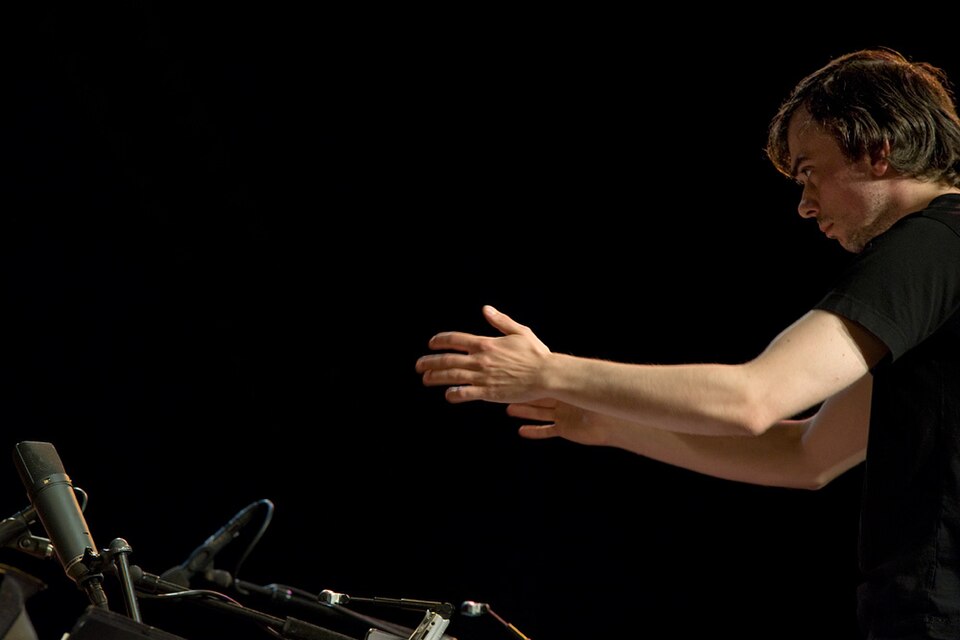
Portrait of Darcy James Argue
Michael Hoefner, moers festival 2009, via Wikimedia Commons · CC BY-SA 3.0

Darcy James Argue (b. 1975)

Biography

Darcy James Argue was born in Vancouver, Canada, and became one of contemporary music’s most innovative big band leaders and composers. He studied at McGill University, New England Conservatory, and Brooklyn College before forming Secret Society in 2005. The 18-piece big band creates music combining jazz tradition with rock, electronics, multimedia, and contemporary composition. Argue has won multiple Grammy nominations and received commissions from major venues and festivals. His work often addresses contemporary social and political issues through musical means. Secret Society’s albums including “Brooklyn Babylon” and “Real Enemies” demonstrate that big band jazz can remain vital and relevant by engaging contemporary culture while maintaining musical sophistication. Argue represents the generation of composers-arrangers creating genuinely new approaches to large ensemble jazz.

Musical Style

Argue’s arranging style combines big band tradition with contemporary elements including rock influences, electronics, cinematic approaches, and multimedia integration. His arrangements feature sophisticated compositions with careful attention to orchestral color, dynamic contrast, and formal development. What distinguishes Argue’s work is its scope and ambition—his music often tells complex stories or addresses serious themes through purely musical means. His voicings are modern and adventurous, incorporating extended techniques and unusual instrumental combinations alongside traditional big band sounds. Argue’s harmonic language draws from jazz, rock, classical music, and personal synthesis. His arrangements often feature dramatic contrasts and cinematic pacing, creating visceral musical experiences. Argue’s style represents cutting-edge contemporary large ensemble jazz: intellectually ambitious, sonically adventurous, and culturally engaged.

Orchestration Techniques

Argue’s orchestration expands traditional big band voicing techniques through integration of rock-influenced power chords, electronic processing, and contemporary classical extended techniques, creating hybrid sonorities that blur genre boundaries. His voicing approach employs stacked fifths and quartal structures alongside tertian harmony, often using parallel perfect fifth motion in brass that evokes rock guitar power chords while maintaining jazz harmonic complexity in inner voices. Sectional writing incorporates rock-influenced techniques: brass sections playing sustained power chord figures against saxophone riffs, or tutti passages where the entire ensemble attacks rhythmic figures with the aggressive unanimity of rock bands rather than traditional jazz section independence. Instrumental combinations include unconventional pairings: bass clarinet doubled by baritone saxophone and bass trombone for extreme low-register weight, piccolo trumpet against flute for high metallic brilliance, or electronic processing applied to acoustic instruments to create timbral transformations. Contrapuntal techniques feature minimalist-influenced phasing patterns where sections gradually move out of and back into rhythmic alignment, creating textural evolution through subtle temporal shifts rather than traditional imitative counterpoint. Register exploitation is extreme and deliberate, with passages exploiting the full orchestral range from bass trombone pedal tones to piccolo trumpet stratosphere, creating dramatic registral contrasts that define formal sections. Rhythmic notation is meticulous and complex, incorporating asymmetrical meters, polymetric superimposition, metric modulation, and rock-influenced backbeat patterns, requiring performers to navigate between jazz swing, straight eighths, and complex contemporary rhythms. Textural approaches range from ambient electronic passages featuring processed acoustic sounds to massive full-band climaxes with rock-influenced intensity, with transitions between extremes handled through careful orchestrational planning. His ensemble configuration expands standard big band to include bass clarinet, multiple flutes and clarinets, additional brass, and electronic reinforcement/processing when desired. Dynamic architecture follows cinematic narrative structures, with long-form developmental arcs building tension over extended passages, sudden dramatic shifts for theatrical effect, and extreme dynamic range from whispered pianissimo to overwhelming fortissimo tutti passages.

Top Albums

Secret Society - “Brooklyn Babylon” (2013)

Argue’s arrangements for this ambitious suite demonstrate his unique approach to contemporary big band. His charts feature sophisticated orchestration, dramatic contrasts, and narrative development creating extended musical story. What makes these arrangements remarkable is their success at sustaining interest over long forms—Argue creates coherent multi-movement work that maintains engagement through varied approaches. His composition “Transit” demonstrates his gift for creating visceral, exciting music with contemporary edge. The album earned Grammy nomination and represents major achievement in contemporary jazz composition.

Secret Society - “Real Enemies” (2016)

Argue’s arrangements here address conspiracy theories and surveillance through musical means, demonstrating big band’s capacity for social commentary. His charts feature his signature sophistication while incorporating multimedia elements. What’s particularly impressive is Argue’s integration of concept and craft—his music serves ideas without sacrificing musical quality. His composition “Real Enemies Suite” shows how big band can engage contemporary issues through sophisticated musical storytelling. The album earned Grammy nomination and widespread critical acclaim.

Secret Society - “Infernal Machines” (2009)

Argue’s debut album’s arrangements showcase his voice already fully formed. His charts feature his signature combination of big band tradition and contemporary approaches. What makes these arrangements notable is their freshness—Argue writes music that honors jazz tradition while sounding completely contemporary. His composition “Phobos” demonstrates his gift for creating exciting, complex music with strong visceral impact. The album earned Grammy nomination and established Argue as major voice in contemporary jazz.