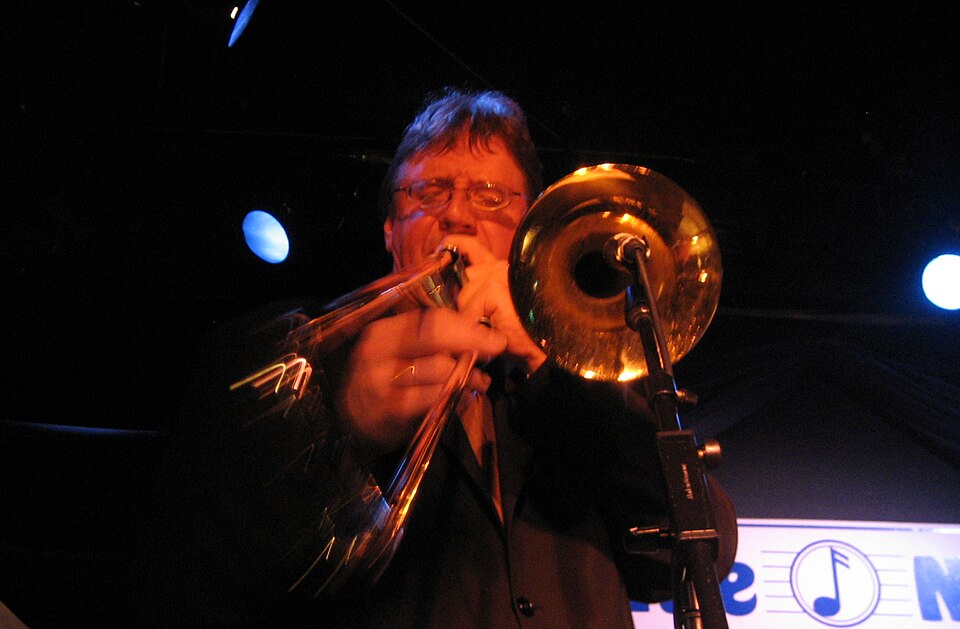
Conrad Herwig (b. 1959)

Biography

Conrad Herwig was born in Oklahoma and became one of contemporary jazz’s leading trombonists and arrangers, particularly known for his Afro-Cuban jazz work. He studied at North Texas State University before establishing himself in New York. Herwig has played with numerous artists from Joe Henderson to the Mingus Big Band while leading his own groups. His “Latin Side of…” series arranges music by John Coltrane, Miles Davis, Joe Henderson, and others in Afro-Cuban contexts, earning Grammy nominations and widespread acclaim. Herwig’s arrangements demonstrate sophisticated understanding of both jazz and Cuban traditions, creating genuine fusions rather than superficial combinations. His success shows that cross-cultural jazz arranging remains vital when executed with authenticity and respect for both traditions.

Musical Style

Herwig’s arranging style fuses bebop and post-bop jazz with authentic Afro-Cuban rhythms and harmonies, demonstrating sophisticated understanding of both traditions. His arrangements feature complex rhythmic structures drawn from Cuban music combined with jazz harmonic sophistication. What distinguishes Herwig’s work is its authenticity—his Afro-Cuban arrangements respect rhythmic traditions while incorporating jazz improvisation and harmony. His voicings incorporate both jazz and Cuban approaches, creating hybrid textures. Herwig writes excellently for brass, drawing on his trombone expertise. His arrangements balance written material and improvisation, providing strong frameworks that support creative freedom. Herwig’s style represents contemporary Afro-Cuban jazz at its finest: rhythmically authentic, harmonically sophisticated, and honoring both traditions while creating personal synthesis.

Orchestration Techniques

Herwig’s orchestration synthesizes post-bop jazz voicings with Afro-Cuban rhythmic structures, employing quartal voicings and McCoy Tyner-influenced stacked fourths that accommodate both modal jazz harmony and clave-based rhythmic frameworks. His brass writing exploits his trombone expertise, featuring extended trombone soli passages in close-position voicings moving through Coltrane-derived harmonic sequences while maintaining compatibility with underlying montuno patterns. Sectional approaches integrate jazz horn section practices with Cuban conjunto traditions: brass figures functioning as guajeos (repeated syncopated patterns) while maintaining bebop-derived melodic sophistication, creating hybrid forms where jazz melodic language sits atop authentic Cuban rhythmic foundation. Instrumental combinations include piano montunos supporting brass melody statements, congas and timbales driving the rhythmic foundation while bass moves between walking bass lines and tumbao patterns depending on rhythmic context. Contrapuntal techniques layer independent rhythmic cells—clave-based brass figures against jazz walking bass against conga patterns—creating polyrhythmic density characteristic of Cuban music while maintaining jazz harmonic progression. Register exploitation places brass in their most powerful middle registers for projection over percussion density, while piano comping operates in middle-to-upper range to avoid muddying bass frequencies occupied by bass and congas. Rhythmic notation is meticulous regarding clave alignment, with specific attention to whether melodic figures fall in 2-3 or 3-2 clave relationship, ensuring authentic Cuban rhythmic feel even when harmonic content derives from jazz sources. Textural approaches alternate between unison melody statements for clarity and dense polyrhythmic sections where each instrument maintains independent patterns, creating the layered rhythmic complexity essential to Afro-Cuban music. His ensemble configurations include expanded Latin rhythm section (piano, bass, congas, timbales, bongo) alongside standard jazz horns, requiring musicians fluent in both traditions. Dynamic architecture builds through rhythmic intensification rather than mere volume increase, with climactic moments achieved through accelerating rhythmic density and tightening clave relationships.

Top Albums

Conrad Herwig - “The Latin Side of John Coltrane” (1996)

Herwig’s arrangements reimagining Coltrane’s music in Afro-Cuban contexts showcase his unique approach. His charts transform Coltrane’s compositions through Cuban rhythms while maintaining their harmonic essence. What makes these arrangements remarkable is their respect for both traditions—Herwig doesn’t merely add Latin rhythms but finds genuine connections between Coltrane’s harmonic thinking and Cuban music. His arrangement of “Giant Steps” in 6/8 demonstrates his creative reimagination. The album earned Grammy nomination and established Herwig’s reputation for cross-cultural arranging.

Conrad Herwig - “The Latin Side of Miles Davis” (2006)

Herwig’s arrangements of Miles Davis material demonstrate continued mastery of Afro-Cuban jazz fusion. His charts honor Davis’s compositions while exploring their possibilities in Cuban rhythmic contexts. What’s particularly impressive is Herwig’s success across different Miles periods—from bebop to fusion, all work in Cuban settings. His arrangement of “All Blues” shows how modal jazz and Cuban music connect naturally. The album demonstrates Herwig’s continued evolution and his deepening understanding of both traditions.

Conrad Herwig - “The Latin Side of Joe Henderson” (2018)

Herwig’s later arrangements show sustained creativity and continued exploration. His charts maintain his signature fusion of jazz and Cuban music while achieving even greater sophistication. What makes these arrangements fascinating is their maturity—decades of experience result in writing of remarkable economy and effectiveness. His arrangement of “Inner Urge” demonstrates how Henderson’s complex compositions work in Cuban contexts. The album proves Herwig remained vital and creative, continually finding fresh approaches to Afro-Cuban jazz arranging.