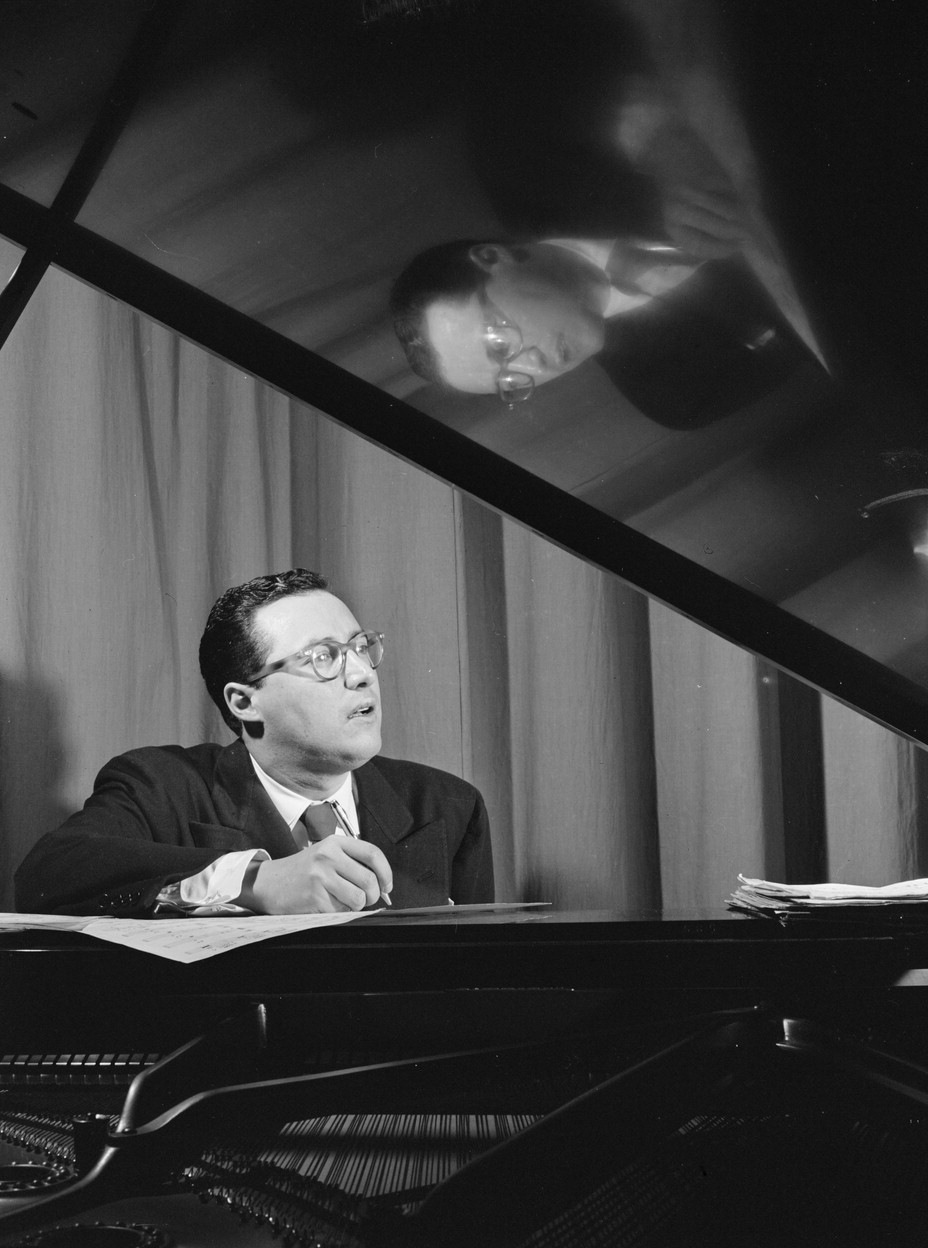
Pete Rugolo (1915-2011)

Biography

Pietro “Pete” Rugolo was born in Patti, Sicily, and immigrated to the U.S. as a child. He studied composition with Darius Milhaud at Mills College, where he absorbed modernist classical techniques. Rugolo arranged for Stan Kenton’s orchestra (1945-1949), creating some of the band’s most adventurous progressive jazz charts. He then worked for Capitol Records as musical director and arranger, working with Nat King Cole, Peggy Lee, and others. Rugolo composed for television (“The Fugitive,” “The Outer Limits”) and film while leading his own recording projects. His work bridged jazz, classical, and popular music.

Musical Style

Rugolo’s arranging style incorporated modernist classical techniques into jazz contexts, creating what Kenton called “progressive jazz.” His arrangements featured advanced harmonies derived from Stravinsky, Milhaud, and other 20th-century composers. Rugolo used dissonance not as momentary effect but as structural element. His orchestrations were elaborate, using the full orchestra palette with chamber-like attention to detail. He often wrote through-composed pieces rather than arrangements of songs with repeated choruses. Rugolo’s style with Kenton was bold and brassy, emphasizing the band’s power. His later work became more refined, incorporating his classical training into commercial contexts. He had a gift for creating dramatic arrangements with strong narrative arcs. Rugolo’s work was controversial—some heard it as jazz’s future, others as pretentious overreach.

Orchestration Techniques

Rugolo’s orchestration technique synthesizes modernist classical procedures with jazz ensemble forces, employing advanced harmonic devices derived from his studies with Milhaud and creating orchestral textures unprecedented in jazz contexts. His characteristic voicing approach utilizes polychords and added-tone sonorities, superimposing unrelated triads to create bitonal effects—major triads a tritone apart, for instance—that produce the harsh, angular quality of Kenton’s progressive sound. Rugolo’s brass writing exploits extreme upper registers, with trumpet parts extending to written high E and beyond, requiring exceptional technical facility and creating the screaming, penetrating sonority that defined Kenton’s orchestra. His sectional writing features massive tutti passages where all brass move in parallel chromatic planing, creating dense harmonic walls of sound that emphasize power over subtlety. Contrapuntally, Rugolo employs devices from classical modernism including ostinato figures, polyrhythmic layering, and melodic inversion, creating complex textures that challenge both performers and listeners. The rhythmic architecture incorporates irregular meters (5/4, 7/4), displaced accents, and additive rhythms that disrupt conventional swing patterns while maintaining forward momentum through sheer orchestral energy. His use of instrumental registers deliberately pushes instruments to their extremes—bass trombones in pedal register, trumpets in stratospheric range, clarinets in altissimo—creating timbral intensity through registral extension. Rugolo’s dynamic scheme employs maximum contrast, with subito fortissimo passages following pianissimo sections, and he frequently uses orchestral unison (all instruments playing same note in multiple octaves) for dramatic punctuation. His string writing in expanded orchestrations treats the section symphonically, with divisi voicings, tremolo effects, and contrapuntal independence from wind sections rather than mere doubling. Rugolo employs tone clusters built from seconds and minor thirds, creating dense chromatic masses that produce dissonance as primary textural element. His woodwind writing features extensive doubling—alto saxophones on clarinets, tenor on bass clarinet—to create hybrid timbres that reinforce the aggressive character of his brass scoring. Rugolo’s signature technique involves through-composed formal structures that avoid jazz conventions of head-solos-head, instead employing classical development procedures including thematic transformation, harmonic sequences, and programmatic elements that create narrative arc within extended compositions.

Top Albums

Stan Kenton Orchestra - “The Innovations Orchestra” (1950-1951)

Rugolo’s most ambitious arrangements for Kenton’s forty-piece orchestra including strings. “Lonesome Road” and “Theme to the West” demonstrate his fusion of jazz, classical, and Americana. What makes these arrangements remarkable is their scope and ambition—Rugolo wasn’t content with conventional big band arranging but sought to create a new genre. The arrangements feature sophisticated counterpoint, advanced harmonies, and unusual instrumental combinations. While commercially unsuccessful, these recordings represent one of jazz’s most adventurous experiments. Rugolo’s vision influenced third stream music and symphonic jazz.

Pete Rugolo - “Music for Hi-Fi Bugs” (1956)

Leading his own orchestra, Rugolo created arrangements showcasing high-fidelity recording technology. The charts demonstrate his range from Brazilian-influenced pieces to tone poems. What’s interesting is how Rugolo uses the studio as an instrument, incorporating stereo effects and unusual mic placements. His arrangement of “Serenade in Blue” shows his gift for reimagining standards with fresh orchestrations. The album demonstrates Rugolo’s evolution beyond progressive jazz toward more accessible yet sophisticated arranging.

Nat King Cole - “Welcome to the Club” (1959, Rugolo arrangements)

Rugolo’s arrangements for Cole demonstrate his ability to work in commercial contexts while maintaining sophistication. His charts support Cole’s intimate vocal style with lush yet transparent orchestrations. What makes these arrangements special is how Rugolo incorporates his advanced harmonic language subtly—the arrangements are beautiful on first listen but reveal more with repeated hearings. His work for Cole shows that sophisticated arranging and commercial success weren’t mutually exclusive. The album represents the mature Rugolo, comfortable in any musical context.