Gil Evans (1912-1988)
Biography
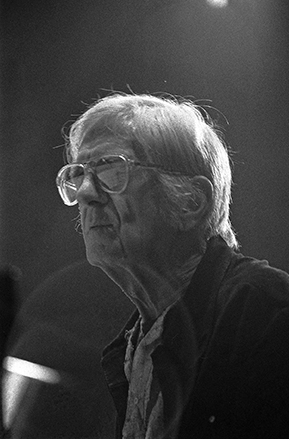
Ian Ernest Gilmore Green was born in Toronto, Canada, and raised in California. He took the surname Evans from his stepfather. Self-taught in music, Evans led his own band in California before becoming chief arranger for Claude Thornhill’s orchestra (1941-1948), where he developed his distinctive approach using French horns and other unconventional jazz instruments. Evans’s basement apartment became the meeting place for the Miles Davis Birth of the Cool sessions (1949-1950), where his arrangements helped define cool jazz. His three landmark collaborations with Davis—“Miles Ahead,” “Porgy and Bess,” and “Sketches of Spain”—established him as jazz’s greatest orchestral arranger. Evans continued experimenting until his death in 1988.
Musical Style
Evans’s arranging style was revolutionary in its use of instrumental color, space, and harmonic sophistication. He approached the jazz orchestra impressionistically, treating instruments as colors on a painter’s palette. Evans incorporated unusual instruments—French horns, tuba, flutes, bass clarinet—to create unique timbres. His voicings were often bottom-heavy, using tuba and low reeds to create a dark, mysterious quality. He was a master of creating space in arrangements, understanding that silence and sparseness could be as powerful as density. Evans’s harmonic language was sophisticated and constantly evolving, incorporating classical influences without losing jazz authenticity. His arrangements were never simply orchestrations of melodies—they were reimaginings that revealed new aspects of compositions. Evans worked slowly and meticulously, spending months on single arrangements, getting every detail perfect.
Orchestration Techniques
Evans’s orchestration technique revolutionized jazz ensemble writing through his use of extended instrumental families and unconventional doublings that created unique timbral composites. His characteristic voicing approach employs spread voicings across wide registral spans, with tuba providing fundamental bass notes, French horns occupying the tenor register, and upper woodwinds (flutes, clarinets, bass clarinet) creating ethereal top colors. Evans frequently writes in open position with intervals of tenths and elevenths between adjacent voices, producing transparent textures where individual instrumental colors remain audible within the ensemble blend. His sectional writing abandons traditional brass-versus-reeds antiphony in favor of mixed instrumental combinations—French horn paired with bass clarinet and tuba, alto flute doubled by muted trumpet—creating hybrid timbres impossible in conventional big band scoring. Contrapuntally, Evans employs slow-moving parallel motion in inner voices while outer voices move obliquely, often using chromatic planing of quartal and quintal harmonies that produce his signature “floating” harmonic effect. His use of pedal tones is extensive, with tuba or bass trombone sustaining root positions while upper structures shift through related but distant harmonic areas. Evans’s rhythmic notation is sparse, often indicating sustained whole notes with strategic rhythmic punctuation, allowing the ensemble to breathe and creating the sense of space that defines his sound. The dynamic architecture of Evans’s scores relies on timbral crescendo—gradually introducing instruments to build intensity rather than increasing volume—and he frequently employs subito piano effects following brief tutti passages. His brass writing avoids high-register screaming in favor of middle-register warmth, often using straight mutes, cup mutes, and harmon mutes in combination to alter fundamental timbral qualities. Evans’s signature technique involves voicing chords with the third or seventh in the bass (first and second inversions), creating rootless sonorities that produce harmonic ambiguity and forward motion through unresolved tension.
Top Albums
Miles Davis - “Miles Ahead” (1957)
Evans’s first collaboration with Davis showcases his orchestral genius. His arrangements transform jazz standards and show tunes into impressionistic soundscapes. What’s revolutionary is how Evans creates continuous musical flow, with each track segueing into the next around Davis’s flugelhorn. The arrangement of “Springsville” demonstrates Evans’s gift for creating mood through orchestration—the piece sounds like a painting of the American West. Evans’s voicings here are remarkably original, using instrumental combinations never before heard in jazz. The album established that jazz arranging could rival classical orchestration in sophistication.
Miles Davis - “Sketches of Spain” (1960)
Evans’s arrangements of Spanish music represent some of his most ambitious work. His 16-minute arrangement of “Concierto de Aranjuez” fuses Spanish classical music with jazz, creating something entirely new. What’s remarkable is how Evans respects the source material while transforming it—this isn’t cultural tourism but genuine synthesis. His orchestration creates Spanish atmosphere without relying on clichés. The album’s colors are darker and more intense than “Miles Ahead,” reflecting Evans’s continued evolution. His arrangement creates space for Davis’s most emotionally naked playing.
Gil Evans - “Out of the Cool” (1960)
Leading his own orchestra, Evans created some of his most adventurous arrangements. “Stratusphunk” and “Sunken Treasure” demonstrate his evolution toward more abstract, impressionistic forms. What’s fascinating is how Evans incorporated avant-garde elements while maintaining accessibility. His arrangement of Kurt Weill’s “Bilbao Song” transforms the original through orchestration that sounds simultaneously European and American. The album shows Evans at his most experimental, pointing toward the free jazz and fusion experiments of the 1960s.