Billy Strayhorn (1915-1967)

Biography

William Thomas “Billy” Strayhorn was born in Dayton, Ohio, and grew up in Pittsburgh. A classically trained pianist and composer, Strayhorn met Duke Ellington in 1938 and joined his organization shortly after. For the next 28 years until his death from esophageal cancer, Strayhorn was Ellington’s closest collaborator, composing and arranging hundreds of pieces for the orchestra. Their collaboration was so close that distinguishing their individual contributions is often impossible. Strayhorn composed standards including “Take the ‘A’ Train,” “Lush Life,” and “Chelsea Bridge.” Despite being openly gay in an intolerant era, Strayhorn maintained his dignity and integrity. His death in 1967 devastated Ellington, who created the memorial album ”…And His Mother Called Him Bill.”

Musical Style

Strayhorn’s arranging style was characterized by lush, impressionistic harmonies influenced by Debussy, Ravel, and Ellington himself. He had a particular gift for delicate, introspective pieces with complex harmonic structures. Strayhorn’s voicings were often more vertical and orchestral than Ellington’s, though their styles became so intertwined that distinction is difficult. He excelled at writing for small groups within the orchestra, creating chamber-like intimacy within big band contexts. Strayhorn had a remarkably sophisticated harmonic palette, using chromaticism, whole-tone scales, and unexpected modulations. His ballad writing was particularly sublime, creating emotional depth through harmonic movement. Unlike some arrangers who imposed similar approaches on every piece, Strayhorn’s arrangements were custom-tailored to each composition’s specific needs. His orchestrations revealed Ellington’s band members’ most lyrical qualities.
Orchestration Techniques

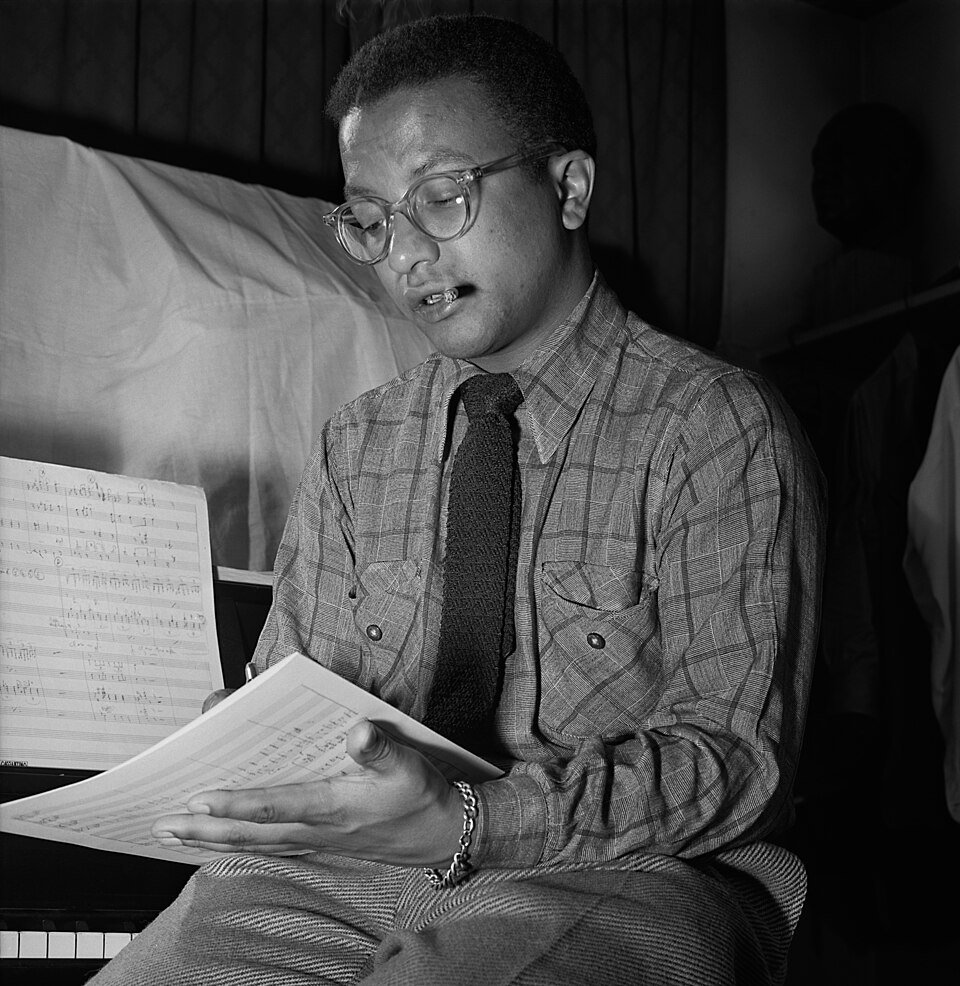
Strayhorn’s orchestration technique reveals a predilection for close-position voicings in the upper woodwinds, frequently employing clusters derived from whole-tone and chromatic scales that create his signature impressionistic shimmer. His sectional writing often features the reeds in four-part close harmony with the lead alto doubled by muted trumpet an octave above, producing an ethereal timbral blend uncommon in standard big band practice. Strayhorn favored stratified textures where brass and reed sections occupy distinct registral planes, with sustained brass pads in middle registers supporting melodic activity in clarinets and flutes above. His contrapuntal approach employs oblique and contrary motion between sections rather than parallel voicings, creating independence of line that recalls chamber music more than traditional big band writing. In pieces like “Chelsea Bridge,” pedal tones in the baritone saxophone and trombone section anchor floating upper structures built on added-tone sonorities and chromatic planing. Strayhorn’s dynamic architecture relies on graduated crescendi through additive orchestration rather than sudden tutti explosions, building intensity through accumulation of timbral layers. He frequently writes concerted passages where all sections move in rhythmic unison but maintain independence through varied articulations—legato in reeds against marcato brass, for instance. His use of instrumental registers exploits the chalumeau register of clarinets for warmth, the upper partials of muted brass for color, and strategic doubling at the unison rather than octave to maintain textural transparency. Rhythmic notation in Strayhorn’s scores often includes specific articulation markings and dynamic hairpins within single phrases, demanding nuanced interpretation from section players. His signature technique involves voice-leading through chromatic inner voices that create constant harmonic motion while outer voices remain relatively static, producing the “floating” quality characteristic of his ballad writing.

Top Albums

Duke Ellington Orchestra - ”…And His Mother Called Him Bill” (1967)

Recorded shortly after Strayhorn’s death, this album features Ellington performing Strayhorn compositions and arrangements as a memorial. Pieces like “Blood Count” (Strayhorn’s final composition), “Lotus Blossom,” and “Rain Check” showcase his most personal, harmonically adventurous writing. What makes this album particularly poignant is hearing how perfectly Strayhorn understood the Ellington orchestra—every arrangement brings out the specific voices he worked with for nearly three decades. The album reveals Strayhorn’s individual voice separate from Ellington, showing his distinct approach was more introspective and impressionistic. Ellington’s solo piano coda on “Lotus Blossom” is one of jazz’s most moving moments.

Duke Ellington and Billy Strayhorn - “The Far East Suite” (1966)

Co-composed and arranged by Ellington and Strayhorn after a State Department tour, this suite represents their collaboration at its peak. Strayhorn’s arrangements on pieces like “Isfahan” and “Bluebird of Delhi” demonstrate his gift for creating exotic atmospheres through orchestration. What’s fascinating is how Strayhorn incorporated Middle Eastern and Asian influences while maintaining jazz authenticity—his approach was to filter these influences through his harmonic language rather than copying surface elements. The arrangements showcase individual orchestra members in featured roles, demonstrating Strayhorn’s intimate knowledge of each player’s strengths.

Billy Strayhorn - “The Peaceful Side” (1961)

One of the rare albums featuring Strayhorn’s own small group, this showcases his arranging for quintet/sextet. His arrangements of “Passion Flower,” “Chelsea Bridge,” and “A Flower Is a Lovesome Thing” reveal his compositional genius and his ability to create lush soundscapes with minimal forces. What’s particularly interesting is hearing Strayhorn’s piano playing, which reveals the harmonic thinking behind his arrangements. The album demonstrates that his arranging gifts weren’t dependent on the Ellington orchestra’s resources—he could create beauty in any format.