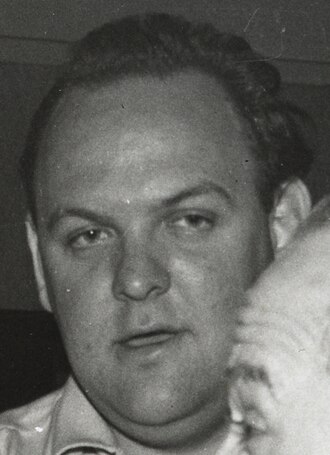
Billy May (1916-2004)
Biography
Edward William “Billy” May Jr. was born in Pittsburgh and studied at the Carnegie Institute of Technology. He played trumpet and arranged for the Glenn Miller Orchestra before moving to California to work as a freelance arranger and conductor. May became one of the most sought-after arrangers in popular music, creating definitive arrangements for Frank Sinatra (“Come Fly with Me,” “Come Swing with Me”), Nat King Cole, Ella Fitzgerald, and others. His work for Capitol Records helped define the label’s sound. May also worked extensively in television and film, scoring numerous productions. He continued arranging and conducting into his 80s.
Musical Style
May’s arranging style was characterized by crisp, swinging brass sections, often featuring his trademark “slurping” saxophones—a sliding effect between notes. His arrangements were bold, energetic, and immediately identifiable. May had a gift for creating exciting introductions that grabbed listeners immediately. His style was more extroverted and showy than subtle, perfect for making records that jumped out of jukeboxes and radios. May’s brass writing was particularly powerful, creating massive ensemble sounds without losing clarity. He understood how to arrange for singers, supporting them without overshadowing while maintaining musical interest. His transitions between sections were smooth and logical. May’s commercial success sometimes obscured his jazz chops—his swing credentials were impeccable and his arrangements always grooved hard.
Orchestration Techniques
May’s orchestration technique emphasizes maximum impact through powerful brass voicings and his signature saxophone effects, creating an immediately recognizable sonic identity. His brass writing employs open-position voicings with trumpets in their brilliant upper register (written D to G above the staff) doubled at the octave below by trombones, producing massive, cutting ensemble sonorities that project through any acoustic environment. The trademark “slurping” saxophone effect involves notating glissandi between chord tones, typically moving chromatically in parallel motion through close-position voicings, creating a sliding textural device that became synonymous with his arranging style. May’s sectional writing favors tutti passages where brass and reeds operate as unified blocks, with staggered entrances creating crescendo effects through orchestral accumulation rather than dynamic markings alone. His contrapuntal approach is relatively straightforward, employing parallel motion in thirds and sixths between sections rather than independent linear counterpoint, ensuring clarity and punch over complexity. The rhythmic architecture relies heavily on accented downbeats and crisp section articulations, with May’s notation specifying exact cutoffs and attack points using staccato dots and accent marks. His use of instrumental registers exploits the piercing quality of trumpets above the staff, the rich sonority of trombones in their middle register, and the full-bodied blend of saxophones in their optimal singing range. May frequently employs pyramid voicings in brass tuttis, building from trombone bass notes upward through the section to create harmonic fullness. His dynamic scheme is theatrical, using subito forte entrances following soft passages and employing ritardando-accelerando figures for dramatic effect. Brass muting is used sparingly but effectively—straight mutes for rhythmic punctuation, cup mutes for softer ballad passages—always maintaining the forward momentum characteristic of his style. May’s string writing, when employed, doubles brass melodies at the unison or octave above, adding sheen without altering the fundamental brass-driven character of his orchestrations.
Top Albums
Frank Sinatra - “Come Fly with Me” (1958)
May’s arrangements for Sinatra represent some of his finest work. The title track’s arrangement perfectly captures the excitement of jet travel with soaring strings and powerful brass. What makes these arrangements special is how May creates excitement while giving Sinatra the support he needs. “Moonlight in Vermont” demonstrates May’s ability to create lush romantic settings, while “Brazilian Crazy” shows his gift for up-tempo swingers. The arrangements are sophisticated without being fussy, always serving the songs and singer. This album represents the peak of popular music arranging in the 1950s.
Billy May - “Sorta-May” (1953)
May’s arrangements for his own orchestra showcase his jazz credibility. Charts like “Fat Man Boogie” and “Charmaine” demonstrate his gifts beyond commercial work. What’s particularly notable is May’s sax section writing, featuring the slurping effect he made famous. The arrangements swing hard with inventive voicings and clever instrumental combinations. May’s band featured top West Coast jazz musicians who execute his arrangements with precision and swing. The album demonstrates that May was a serious jazz arranger who happened to also be commercially successful.
Nat King Cole - “Just One of Those Things” (1957)
May’s arrangements for Cole emphasize the singer’s swing side rather than his ballad persona. The title track’s arrangement builds gradually from subtle accompaniment to full orchestra, demonstrating May’s gift for pacing. What’s interesting is how May creates jazz excitement while maintaining radio-friendly accessibility. His arrangement of “Blues in the Night” showcases his ability to handle darker material with appropriate atmospheric touches. The album shows May’s versatility—he could arrange for any singer in any style while maintaining his distinctive voice.