Jazz arranging · Swing & the Big Band Era
LarryClinton
1909–1985 arranger · composer · orchestrator
Clinton's arranging style was characterized by sophistication, melodic focus, and careful orchestration.
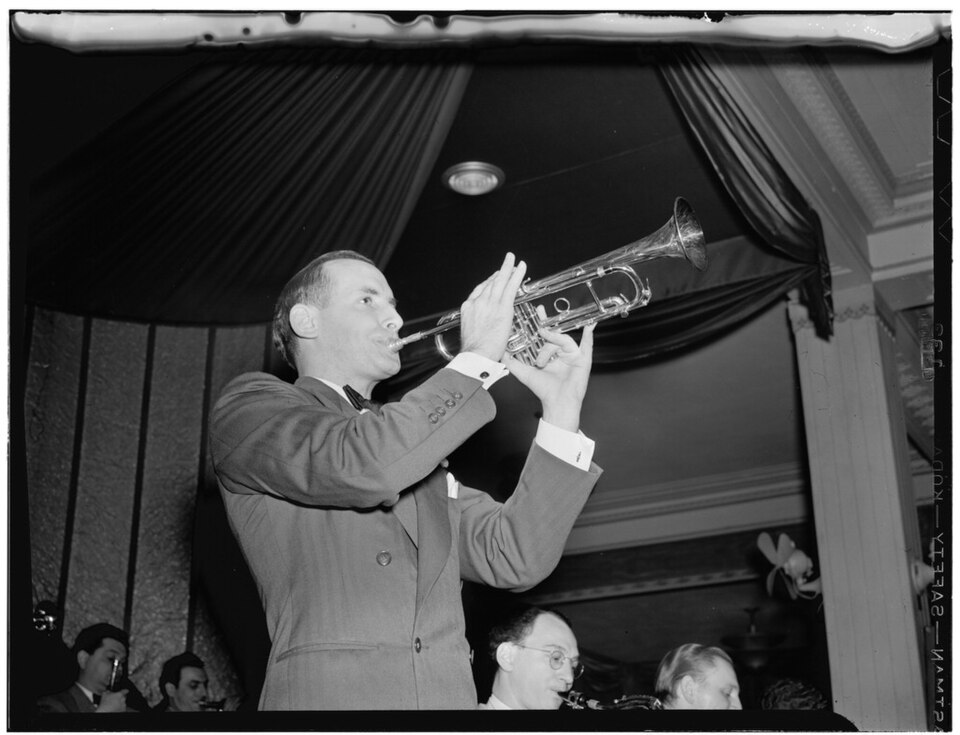
,_between_1938_and_1948)_(LOC)_(4932353726).jpg)
- Predominant era
- Swing & the Big Band Era
- Lifespan
- 1909–1985
- Signature
- iridescent color
Bio · 36 words
Larry Clinton was born in Brooklyn and studied trumpet before focusing on arranging. He arranged for several bands including those of the Dorsey Brothers, Glen Gray, and Bunny Berigan before forming his own orchestra in 1938.
01
Musical style
Sound DNA
Five shared dimensions make the arranger’s musical priorities visible at a glance.
Iridescent
Instrumental color leads the design.
Compact
Ideas arrive in tightly packed frames.
Expansive
Wide spans define the orchestral frame.
Transparent
Individual lines stay easy to follow.
Elastic
The rhythmic feel expands and contracts.
02
Orchestration
Technique deck
Select a card to spotlight a device drawn from this arranger’s orchestral language.
03
Music first
Scores & orchestras
Switch recordings to compare how this arranger’s musical priorities shape each orchestral profile.
My Reverie · 1938-1941
Rêverie
Clinton's arrangements of classical-based material showcase his sophisticated approach.
Listen forNotice how color shapes the orchestral profile.
Find listening example on YouTubeProfile derived from the arranger’s documented style and recording notes; exact instrumentation is not asserted.
Deep Purple · 1939
Deep Purple
Clinton's arrangement of this Mitchell Parish/Peter DeRose song became the definitive version.
Listen forNotice how color shapes the orchestral profile.
Find listening example on YouTubeProfile derived from the arranger’s documented style and recording notes; exact instrumentation is not asserted.
Our Love · 1939
Romeo and Juliet,
Based on Tchaikovsky's "Romeo and Juliet," Clinton's arrangement demonstrates his ability to adapt romantic classical themes for swing orchestra.
Listen forNotice how color shapes the orchestral profile.
Find listening example on YouTubeProfile derived from the arranger’s documented style and recording notes; exact instrumentation is not asserted.
04
Start here
Three essential albums
One line each—enough context to choose the next listen.
- 01 1938-1941 My ReverieLarry Clinton Orchestra Clinton's arrangements of classical-based material showcase his sophisticated approach.
- 02 1939 Deep PurpleLarry Clinton Orchestra featuring Bea Wain Clinton's arrangement of this Mitchell Parish/Peter DeRose song became the definitive version.
- 03 1939 Our LoveLarry Clinton Orchestra Based on Tchaikovsky's "Romeo and Juliet," Clinton's arrangement demonstrates his ability to adapt romantic classical themes for swing orchestra.