Jazz arranging · Swing & the Big Band Era
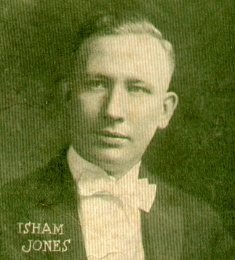
IshamJones
1894–1956 arranger · composer · orchestrator
Jones's arranging style was sophisticated and melodically focused, balancing commercial appeal with musical substance.

- Predominant era
- Swing & the Big Band Era
- Lifespan
- 1894–1956
- Signature
- iridescent color
Bio · 26 words
Isham Edgar Jones was born in Iowa and became one of the most successful bandleaders of the 1920s-1930s, known for both commercial success and jazz credibility.
01
Musical style
Sound DNA
Five shared dimensions make the arranger’s musical priorities visible at a glance.
Iridescent
Instrumental color leads the design.
Compact
Ideas arrive in tightly packed frames.
Layered
Registers work as distinct layers.
Transparent
Individual lines stay easy to follow.
Suspended
Motion unfolds with patience.
02
Orchestration
Technique deck
Select a card to spotlight a device drawn from this arranger’s orchestral language.
03
Music first
Scores & orchestras
Switch recordings to compare how this arranger’s musical priorities shape each orchestral profile.
It Had to Be You · 1924-1930
It Had to Be You
Jones's arrangements of his own compositions showcase his gifts as both composer and arranger.
Listen forNotice how color shapes the orchestral profile.
Find listening example on YouTubeProfile derived from the arranger’s documented style and recording notes; exact instrumentation is not asserted.
I'll See You in My Dreams · 1924-1934
On the Alamo
This collection features Jones's most sophisticated arrangements.
Listen forNotice how color shapes the orchestral profile.
Find listening example on YouTubeProfile derived from the arranger’s documented style and recording notes; exact instrumentation is not asserted.
Swingin' Down the Lane · 1923-1926
Swingin' Down the Lane
Earlier Jones arrangements show his style developing.
Listen forNotice how color shapes the orchestral profile.
Find listening example on YouTubeProfile derived from the arranger’s documented style and recording notes; exact instrumentation is not asserted.
04
Start here
Three essential albums
One line each—enough context to choose the next listen.
- 01 1924-1930 It Had to Be YouIsham Jones Orchestra Jones's arrangements of his own compositions showcase his gifts as both composer and arranger.
- 02 1924-1934 I'll See You in My DreamsIsham Jones Orchestra This collection features Jones's most sophisticated arrangements.
- 03 1923-1926 Swingin' Down the LaneIsham Jones Orchestra Earlier Jones arrangements show his style developing.