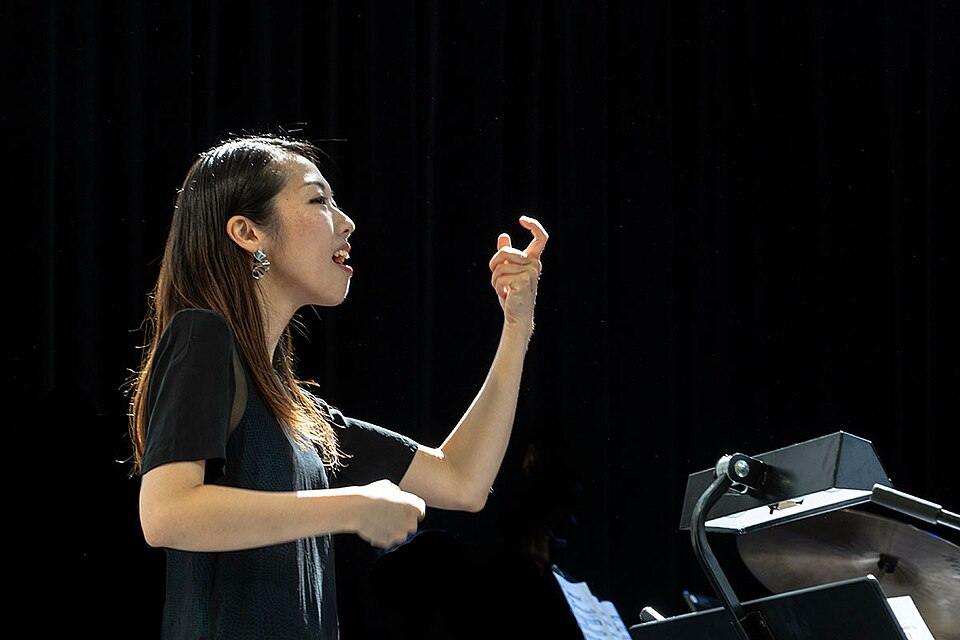
Miho Hazama (b. 1986)

Biography

Miho Hazama was born in Tokyo, Japan, and became an internationally acclaimed conductor, composer, and arranger. She studied at Manhattan School of Music and Eastman before establishing herself internationally. Hazama leads m_unit, her own big band, and has conducted major orchestras worldwide including the Danish Radio Big Band, WDR Big Band, and Metropole Orchestra. Her arrangements feature sophisticated contemporary approaches combining Japanese and Western influences. Hazama has won multiple awards including Grammy nominations. She represents the new generation of international jazz arrangers demonstrating jazz’s truly global nature. Her success shows that jazz leadership increasingly comes from diverse international sources, enriching the music through multiple cultural perspectives. Hazama’s work proves that jazz’s future is genuinely international.

Musical Style

Hazama’s arranging style features sophisticated contemporary approaches combining Japanese sensibilities with Western jazz traditions, creating unique cross-cultural syntheses. Her arrangements demonstrate complete mastery of large ensemble writing with careful attention to orchestral color, dynamics, and formal development. What distinguishes Hazama’s work is its successful cultural integration—her charts genuinely merge Japanese and Western elements rather than merely juxtaposing them. Her voicings are modern and adventurous, incorporating extended techniques and unusual colors. Hazama’s harmonic language draws from jazz, contemporary classical music, and Japanese influences, creating rich, distinctive textures. Her conducting brings clarity and precision to complex scores. Hazama’s style represents contemporary international jazz: culturally synthesized, technically sophisticated, and demonstrating jazz’s global evolution.

Orchestration Techniques

Hazama employs pentatonic-based voicing structures that reference Japanese scalar traditions while incorporating Western jazz tensions, creating hybrid sonorities where perfect fourths and fifths coexist with major sevenths and sharp elevenths. Her sectional writing features metric precision where brass and saxophone sections execute complex rhythmic unisons with exactitude characteristic of Japanese ensemble traditions, maintaining impeccable timing even through intricate polyrhythmic passages. Soli passages utilize cluster voicings based on pentatonic collections, with seconds and fourths creating bright, open sonorities that evoke Japanese court music (gagaku) translated into jazz instrumentation. Instrumental combinations reflect orchestral training: piccolo doubled with glockenspiel creates crystalline upper-register colors reminiscent of Japanese traditional instruments, while bass clarinet paired with tuba and bass provides weighted low-end density. Contrapuntal approaches include precisely notated multi-section independence where three or four distinct melodic lines operate simultaneously with no voice more important than others—a democratic texture reflecting Japanese ensemble aesthetics. Register exploitation emphasizes extreme clarity: piccolo and soprano saxophone operate in highest ranges for brilliance, brass utilizes middle registers with controlled vibrato for blend, and low instruments provide harmonic foundations with exact pitch requirements. Rhythmic notation incorporates exact metric modulations with tempo relationships precisely calculated (quarter = 120 to dotted quarter = 80), creating smooth temporal transitions between sections. Textural approaches include gradual timbral transformations where instrumental colors shift incrementally through carefully orchestrated doublings, with crossfades notated precisely to achieve seamless metamorphosis. Hazama favors expanded percussion sections including Japanese instruments (taiko, temple blocks) integrated with standard jazz kit. Her dynamic architecture features carefully terraced dynamic levels with specific markings indicating exact dynamic progression from pppp to ffff across extended passages. The signature technique involves brass chord voicings where each instrument enters on successive sixteenth-notes, creating rapid arpeggiation effects that blur harmonic and melodic distinctions while maintaining vertical harmonic coherence—a technique requiring the ensemble precision that Hazama’s conducting ensures.

Top Albums

m_unit - “Imaginary Visions” (2013)

Hazama’s arrangements for her big band showcase her distinctive cross-cultural approach. Her charts feature sophisticated orchestration combining Japanese and Western influences organically. What makes these arrangements remarkable is their successful cultural synthesis—Hazama creates genuinely hybrid music rather than simple combinations. Her composition “Rolling Down” demonstrates her gift for creating memorable themes with sophisticated development. The work earned Grammy nomination and established Hazama internationally.

m_unit - “Dancer in Nowhere” (2016)

Hazama’s continued work demonstrates sustained excellence and deepening sophistication. Her arrangements maintain her signature cross-cultural synthesis while achieving even greater clarity and emotional depth. What’s particularly impressive is Hazama’s range—these arrangements span from delicate chamber textures to powerful orchestral climaxes. Her composition “Time River” showcases her ability to create extended forms that sustain interest. The album earned Grammy nomination.

International Conducting Career

Hazama’s work conducting major international big bands demonstrates her standing among contemporary jazz’s elite. Her interpretations of others’ arrangements alongside her own work show complete musical understanding. What makes this work important is its demonstration of jazz’s international leadership—Hazama represents the generation leading jazz globally, not merely within national contexts. Her success proves jazz’s future is truly international, enriched by diverse cultural perspectives.