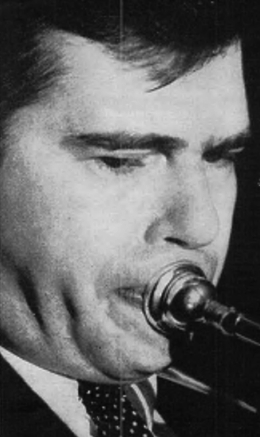
Bob Brookmeyer (1929-2011)

Biography

Bob Brookmeyer’s later period (1990s-2000s) represented the culmination of his evolution toward sophisticated, through-composed modernism. After earlier success as valve trombonist and arranger with Gerry Mulligan and others, Brookmeyer’s mature work with the New Art Orchestra and various European bands demonstrated his complete transformation as composer-arranger. He abandoned conventional jazz forms, creating complex compositions that maintained improvisation elements within highly organized structures. Brookmeyer won multiple Grammy Awards and received widespread acclaim for his late works. His teaching at New England Conservatory influenced younger generations. Brookmeyer’s mature style influenced contemporary large ensemble composition significantly, demonstrating that jazz could sustain serious compositional ambition rivaling contemporary classical music. His late works represent perhaps jazz’s most sophisticated marriage of composition and improvisation.

Musical Style

Brookmeyer’s mature arranging style featured through-composed structures with sophisticated harmonies, complex formal development, and carefully integrated improvisation. His arrangements moved beyond conventional jazz forms into extended compositions organized by purely musical logic. What distinguished Brookmeyer’s late work was its compositional rigor combined with jazz feeling—his music was highly organized yet never felt academic or cold. His voicings were complex and colorful, incorporating contemporary classical techniques within jazz contexts. Brookmeyer’s harmonic language drew from bebop, contemporary classical music, and personal synthesis, creating rich, challenging textures. His arrangements balanced written complexity with improvised elements, integrating solos organically rather than merely providing spaces between composed sections. Brookmeyer’s style represented jazz composition at its most ambitious and sophisticated.

Orchestration Techniques

Brookmeyer’s late-period orchestration abandoned conventional sectional thinking in favor of fluid instrumental groupings that reformed continuously throughout compositions. His voicing structures employed quartal and quintal harmony extensively, stacking perfect fourths across the brass section to create ambiguous, non-tertian sonorities. Sectional writing dissolved traditional boundaries: individual instruments from different families combined into temporary choirs based on timbral or registral logic rather than instrumental category. Concerted passages featured non-parallel voice leading where each part maintained melodic independence while contributing to complex vertical sonorities. Instrumental doublings served contrapuntal rather than reinforcing functions—bass clarinet doubling valve trombone at the tritone created dissonant heterophony, while flute and muted trumpet in parallel minor ninths generated intentional textural friction. Contrapuntal techniques included retrograde and inversion of thematic material distributed across the ensemble, with augmentation and diminution occurring simultaneously in different instrumental voices. Register exploitation was extreme: Brookmeyer wrote trumpet parts exploring altissimo range (written E6 and above) against bass trombone pedal tones, creating four-octave vertical spreads. Rhythmic notation incorporated complex metric superimposition, with different sections operating in independent time signatures that aligned only at structural downbeats. Textural approaches ranged from pointillistic fragmentation where single notes passed between instruments to dense chromatic clusters voiced across the full ensemble. His signature technique involved motivic cells that generated entire compositional structures—a three-note cell would appear in original form, inversion, retrograde, and retrograde inversion across different transposition levels simultaneously, creating twelve-tone-influenced density within jazz performance practice.

Top Albums

New Art Orchestra - “New Works” (1997)

Brookmeyer’s arrangements for his European big band showcase his mature compositional approach. His charts feature sophisticated structures with complex harmonies and careful formal development. What makes these arrangements remarkable is their success at sustaining extended forms through purely musical means—Brookmeyer creates coherent large-scale works without relying on conventional jazz forms. His composition “ABC Blues” demonstrates how blues feeling can exist within highly sophisticated compositional frameworks. The work represents Brookmeyer’s mature synthesis of composition and improvisation.

Bob Brookmeyer - “Waltzing with Zoe” (2006)

Brookmeyer’s late arrangements demonstrate his continued evolution into his 70s. His charts achieve even greater sophistication while maintaining emotional directness. What’s particularly impressive is Brookmeyer’s ability to write music of extreme complexity that nonetheless communicates powerfully. His suite “Waltzing with Zoe” demonstrates his gifts in extended form, creating multi-movement work of symphonic scope. The album won Grammy and represents perhaps Brookmeyer’s greatest achievement.

Bob Brookmeyer - “Spirit Music” (2006)

Brookmeyer’s final arrangements show sustained creativity until the end of his life. His charts feature his signature sophistication with perhaps even greater emotional depth. What makes these arrangements fascinating is their perfect balance—Brookmeyer achieves maximum compositional complexity while maintaining jazz essence and emotional impact. His late work proves that jazz composition could rival contemporary classical music in sophistication while remaining distinctly jazz. This represents the pinnacle of jazz arranging as serious composition.