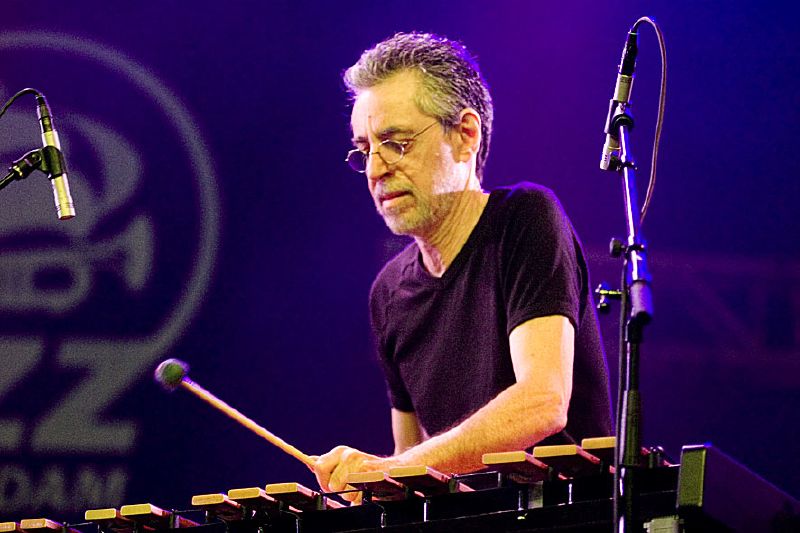
Mike Mainieri (b. 1938)

Biography

Mike Mainieri was born in the Bronx, New York, and became an influential vibraphonist, composer, and bandleader. He studied at Juilliard before establishing himself in New York’s jazz and studio scenes. Mainieri founded Steps Ahead (originally Steps) in 1979, an influential fusion group featuring top New York musicians. The band helped define contemporary jazz in the 1980s-90s with sophisticated compositions and virtuosic playing. Mainieri has also worked extensively in studios and with various artists. His work demonstrates that vibraphone could lead electric jazz groups while maintaining sophisticated musical standards. Steps Ahead’s success showed that fusion could evolve beyond 1970s approaches into more nuanced, compositionally sophisticated directions. Mainieri’s career spans bebop, fusion, and contemporary jazz, demonstrating sustained adaptability and creativity.

Musical Style

Mainieri’s arranging style for Steps Ahead combines jazz improvisation with contemporary rhythms, sophisticated harmonies, and polished production. His arrangements feature tight ensemble writing balanced with room for individual expression. What distinguishes Mainieri’s work is its combination of compositional substance and improvisational freedom—his charts provide strong frameworks while encouraging creative interaction. His voicings make effective use of vibraphone as lead voice alongside saxophones and keyboards. Mainieri’s harmonic language draws from bebop and contemporary jazz while incorporating fusion elements. His arrangements feature complex rhythmic structures and careful attention to group dynamics. Mainieri’s style represents 1980s-90s contemporary jazz: sophisticated, virtuosic, and balancing composition with improvisation.

Orchestration Techniques

Mainieri’s orchestration exploits vibraphone’s unique timbral and sustaining qualities, using motor-off sustained chords as harmonic pads while saxophone provides melodic lines, creating textural layering uncommon in traditional jazz settings. His voicing approach employs extended chord structures (ninths, elevenths, sharp elevenths) voiced across vibraphone and keyboards simultaneously, with each instrument occupying distinct registral space to avoid frequency masking while creating dense harmonic fields. Sectional writing in his small ensemble context features vibraphone-saxophone unisons in parallel motion, where the metallic sustain of vibes blends with saxophone’s reedy timbre to create hybrid sonority characteristic of Steps Ahead’s signature sound. Instrumental combinations prioritize timbral contrast and complement: vibraphone’s bell-like attack against saxophone’s smooth legato, or synthesizer pads supporting vibraphone ostinatos, each element contributing unique color to the overall texture. Contrapuntal techniques include layered independent lines where vibraphone maintains harmonic ostinato patterns while saxophone and keyboards execute melodic material, creating polyrhythmic density from small ensemble forces. Register exploitation places vibraphone predominantly in its middle-to-upper range where its sustaining qualities are most pronounced, while bass operates in low register with complex rhythmic patterns, ensuring clear frequency separation. Rhythmic notation reflects 1980s fusion practices, with precise notation of syncopated patterns, odd-meter phrases (7/8, 11/8), and metric modulations that define the style’s rhythmic sophistication, requiring all musicians to execute with studio precision. Textural approaches alternate between sparse, spacious passages highlighting individual instrument timbres and dense, layered sections where all instruments contribute to polyphonic complexity. His ensemble configuration—vibraphone, saxophone, keyboards, bass, drums—prioritizes virtuosic individual contribution within tight ensemble framework. Dynamic architecture builds through additive layering and rhythmic intensification, with climaxes achieved through increasing density and rhythmic complexity rather than volume alone, reflecting the sophisticated approach characteristic of contemporary jazz fusion.

Top Albums

Steps Ahead - “Steps Ahead” (1983)

Mainieri’s arrangements for this landmark fusion album showcase the group’s sophisticated approach. His charts feature tight ensemble passages, complex rhythms, and sophisticated harmonies while leaving room for extended improvisation. What makes these arrangements notable is their balance—Mainieri writes substantial compositional material without constraining the virtuosic musicians. His composition “Both Sides of the Coin” demonstrates his gift for creating memorable themes with sophisticated development. The album helped define 1980s contemporary jazz.

Steps Ahead - “Modern Times” (1984)

Mainieri’s arrangements here demonstrate the group’s continued evolution. His charts maintain sophisticated ensemble writing while incorporating more electronic elements and contemporary production. What’s particularly impressive is how Mainieri adapts his arranging to changing personnel—these arrangements work for the specific musicians in the band. His composition “Uncle Bob” showcases his ability to create exciting, swinging music with contemporary edge. The album represents peak Steps Ahead.

Steps Ahead - “NYC” (2004)

Mainieri’s later arrangements show the group’s return after hiatus with mature, refined approach. His charts maintain the sophisticated compositional approach while achieving greater economy and focus. What makes these arrangements fascinating is their combination of experience and freshness—Mainieri brings decades of knowledge while maintaining creative vitality. His composition “Nardis” arrangement demonstrates how familiar material can be completely transformed. The album proves Steps Ahead remained relevant in the 21st century.