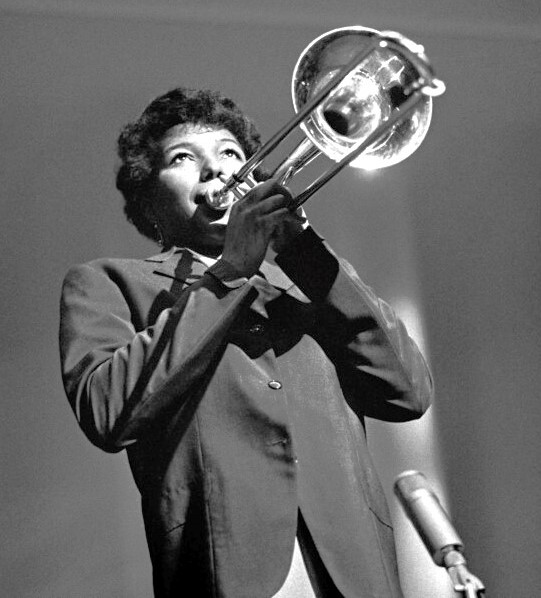
Melba Liston (1926-1999)
Biography
Melba Doretta Liston was born in Kansas City and became one of jazz’s most important female trombonists and arrangers. She played and arranged for Gerald Wilson, Dizzy Gillespie, Count Basie, and many others. Liston was particularly close to Randy Weston, arranging many of his Afrocentric compositions. She broke gender barriers in a male-dominated field, earning respect for her musicianship and arranging skills. Liston also worked extensively in education and with Jamaica’s music scene. After suffering a stroke in the 1980s, she continued arranging despite physical limitations. Liston’s contributions to jazz arranging, particularly for Afro-centric jazz, were immense.
Musical Style
Liston’s arranging style was characterized by sophisticated voicings, warm tonal colors, and deep understanding of African and Caribbean influences. Her arrangements featured careful attention to instrumental blend and balance. Liston had a gift for creating lush, romantic textures alongside powerful, exciting ensemble passages. Her style incorporated blues feeling with modern harmonies, creating arrangements that were both soulful and sophisticated. Liston’s work with Randy Weston explored African musical connections, incorporating African rhythms and melodic concepts into jazz arranging. Her voicings were rich and full, demonstrating her understanding of harmony from her trombone playing. Liston’s arrangements always served the music and musicians, never drawing undue attention to arranging cleverness.
Orchestration Techniques
Liston’s orchestration technique demonstrates sophisticated harmonic sensibility with particular attention to warm tonal colors and balanced sectional writing that serves the music’s spiritual and cultural dimensions. Her characteristic voicing approach employs rich four-part trombone section writing that exploits her intimate knowledge of the instrument’s resonance, with voices spread across the trombone’s optimal registers to create warmth and blend impossible to achieve with less understanding of the instrument’s timbral properties. Liston’s sectional writing balances brass and reed sections in complementary roles, with antiphonal passages that employ call-and-response patterns reflecting African musical traditions while maintaining jazz harmonic sophistication. Her contrapuntal technique incorporates African-derived rhythmic patterns as structural elements, with ostinato figures in bass and lower brass supporting melodic development in upper voices, creating layered textures that honor African musical principles while operating within jazz ensemble contexts. The rhythmic architecture features polyrhythmic layering where different sections operate with rhythmic independence, with Caribbean and African rhythmic patterns integrated authentically rather than superficially, reflecting her deep understanding of Afrodiasporic musical traditions. Liston’s use of instrumental registers emphasizes the warmth of middle voices, with trombones operating in their lyrical ranges and saxophones in their most vocal registers, creating ensemble blend that prioritizes tonal beauty over cutting power. Her dynamic scheme employs gradual crescendi through orchestral accumulation, building intensity by adding instrumental layers rather than increasing volume, creating organic dynamic arcs that support emotional narrative. Brass voicings in Liston’s scores feature drop-2 and drop-3 configurations that create fullness while maintaining clarity, with her trombone writing particularly noteworthy for its understanding of how slide positions and breath support affect tonal production. She employs blues-inflected melodic material with bebop-derived harmonic vocabulary, creating arrangements where blues feeling permeates sophisticated chord progressions through careful voice-leading in inner parts. Liston’s saxophone writing features close-position voicings that move in parallel motion with chromatic alterations providing harmonic color without obscuring melodic clarity. Her use of pedal tones anchors harmonically adventurous upper structures, with baritone saxophone or bass trombone sustaining roots while upper voices explore extended harmonies. Liston’s signature technique involves creating arrangements that support soloists through sophisticated yet unobtrusive backgrounds, writing countermelodies and harmonic fills that enhance without competing, demonstrating her commitment to serving the music rather than showcasing arranging virtuosity.
Top Albums
Dizzy Gillespie - “Dizzy Gillespie at Newport” (1957, Liston arrangements)
Liston’s arrangements for Gillespie’s band demonstrate her command of bebop big band writing. Her charts feature sophisticated harmonies and exciting rhythmic energy. What makes Liston’s arrangements special is their perfect balance—they’re complex enough to challenge musicians yet swinging enough to excite audiences. Her voicings are particularly notable, creating thick, rich textures that enhance Gillespie’s trumpet. These arrangements established Liston as a major voice in jazz arranging.
Randy Weston - “Uhuru Afrika” (1960, Liston arrangements)
Liston’s arrangements for Weston’s ambitious suite demonstrate her gift for large-scale orchestral jazz. The arrangements incorporate African influences while maintaining jazz authenticity. What’s particularly remarkable is how Liston creates sophisticated orchestrations that honor African traditions without exoticizing them. Her understanding of African rhythms and melodies informs arrangements that are genuinely Afrocentric. This work influenced how jazz could engage with African music seriously and respectfully.
Melba Liston - “Melba Liston and Her ‘Bones” (1958)
Leading her own trombone choir, Liston’s arrangements showcase her understanding of brass writing. The charts demonstrate her gift for creating variety with limited timbral resources—all trombones. What makes these arrangements fascinating is how Liston creates interest through voicing, dynamics, and rhythmic variety rather than instrumental color. Her arrangements prove that limitations can inspire creativity, resulting in unique sounds and approaches.