Jerry Gray (1915-1976)
Biography
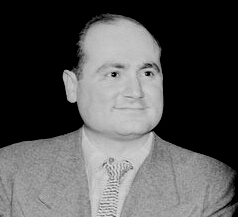
Jerry Gray was born Generoso Graziano in Boston to Italian immigrant parents. He studied violin at the Boston Conservatory and worked as a violinist before taking up arranging. Gray arranged for Artie Shaw’s orchestra (1936-1939), where his charts helped establish Shaw’s sophisticated sweet-swing sound. He then became Glenn Miller’s chief arranger (1939-1942), creating many of Miller’s most famous arrangements including “String of Pearls” and “Pennsylvania 6-5000.” After Miller’s death, Gray led the Glenn Miller Orchestra (1945-1950) before leading his own bands. He continued working in music until his retirement.
Musical Style
Gray’s arranging style emphasized smooth, melodic lines and precise ensemble blend. His arrangements for Shaw and Miller were sophisticated yet accessible, perfect for radio play and dancing. Gray had a particular gift for creating memorable introductions—his intro to “String of Pearls” is one of the most recognizable in popular music. His style featured clear formal structures with smooth transitions between sections. Gray’s reed section voicings were particularly lush and well-blended, and he understood how to feature clarinet lead (for Shaw and Miller) effectively. His arrangements balanced arranged passages and solo space perfectly. While not as adventurous as some arrangers, Gray’s craftsmanship was impeccable—every note served a purpose. His arrangements had a polished quality that made them ideal for broadcasting.
Orchestration Techniques
Gray’s orchestration technique exemplifies the polished swing-era studio sound through precise sectional balance, smooth voice-leading, and memorable melodic hooks that translate effectively to radio broadcast. His characteristic voicing approach employs the clarinet-lead reed section sound, with B-flat clarinet doubled at the octave below by alto saxophones in close-position four-part harmony, creating the signature Glenn Miller timbre that defined the period’s popular sound. Gray’s brass writing favors middle-register voicings with trumpets around written high B-flat, allowing for sustained power without listener fatigue, while trombones provide harmonic foundation in drop-2 configurations. His sectional writing maintains clear antiphonal relationships, with brass and reed sections trading phrases in predictable but effective call-and-response patterns that create formal coherence. Contrapuntally, Gray employs relatively simple parallel motion between sections, with occasional contrary motion in bass lines to provide harmonic direction, prioritizing blend and clarity over linear complexity. The rhythmic architecture of his arrangements emphasizes precise section articulation, with staccato markings on pickup notes and accented downbeats that create the crisp, dancing quality essential for ballroom performance. Gray’s dynamic scheme uses graduated crescendi through orchestral layering, typically beginning with rhythm section, adding reeds, then introducing brass for climactic passages. His use of instrumental doublings is systematic rather than coloristic—alto saxophones doubling clarinet melody, trombones doubling trumpet lines at the octave—creating reinforcement rather than timbral complexity. Gray’s introductions are architecturally significant, often featuring independent melodic material that establishes mood before stating main themes, as exemplified in “String of Pearls” where the opening brass figure becomes iconic. He employs pedal tones sparingly, using sustained bass notes primarily in ballad contexts to create harmonic stability. Brass muting in Gray’s scores serves functional purposes—straight mutes for soft passages, open brass for climaxes—without the coloristic experimentation of more progressive arrangers. His signature technique involves creating compact, economical arrangements where every phrase serves structural purpose, eliminating ornamental passages in favor of melodic directness that ensures immediate listener accessibility and broadcast clarity.
Top Albums
Glenn Miller Orchestra - “The Complete Glenn Miller” (1939-1942, Gray arrangements)
Gray’s arrangements dominate this collection, including “String of Pearls,” “Pennsylvania 6-5000,” and “Elmer’s Tune.” What makes “String of Pearls” particularly remarkable is its perfect economy—the arrangement wastes no notes, with every section contributing to the overall effect. The introduction alone is a masterclass in creating memorable hooks. Gray’s arrangements helped define the Miller sound, though Miller himself often gets credit for Gray’s work. “Pennsylvania 6-5000” demonstrates Gray’s gift for creating excitement through build-ups and dynamic contrasts. These arrangements became embedded in American popular culture.
Artie Shaw Orchestra - “Begin the Beguine” (1938-1939, Gray arrangements)
Gray’s earlier work for Shaw shows his arranging skills before his Miller fame. His arrangement of “Begin the Beguine” became Shaw’s theme and demonstrates Gray’s ability to take a relatively obscure Cole Porter song and transform it into a hit through arranging. What’s fascinating is how Gray builds the arrangement gradually, adding layers until the explosive final choruses. His arrangements for Shaw were generally more jazz-oriented than his Miller work, with more space for improvisation. These charts demonstrate Gray’s range—he could arrange in various styles depending on the bandleader’s needs.
Jerry Gray Orchestra - “Smoke Rings” (1955)
Leading his own orchestra, Gray revisited his Glenn Miller arrangements and created new charts. What makes this album valuable is hearing Gray’s interpretation of his own arrangements—his choices reveal his intentions. The album demonstrates that Gray’s arranging concepts from the 1940s remained effective in the 1950s. His new arrangements show some evolution toward more modern harmonies while maintaining his essential style. The album showcases Gray’s gifts independent of Miller’s fame—he was a significant arranger in his own right.