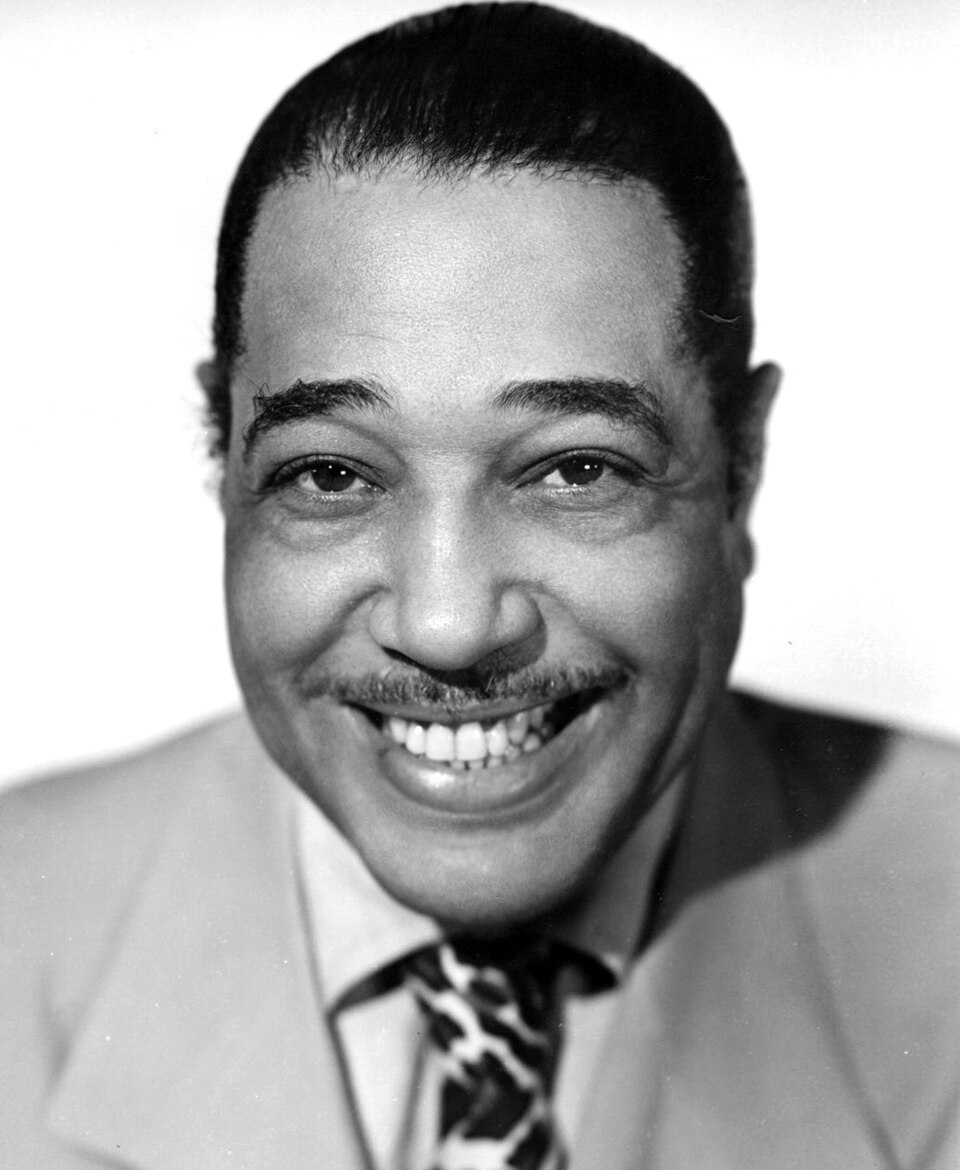
Duke Ellington (1899-1974)
Biography
Edward Kennedy “Duke” Ellington was born in Washington, D.C., to a middle-class family that encouraged his musical pursuits. He began piano lessons at age seven and was composing by his teens. Moving to New York in 1923, Ellington established his orchestra at the Cotton Club in 1927, beginning a partnership with the venue that would launch his career. Unlike most bandleaders, Ellington composed and arranged specifically for the individual voices in his orchestra, creating a unique ensemble sound. He continued leading his orchestra for nearly 50 years until his death in 1974, composing over 1,000 pieces including extended works like “Black, Brown and Beige.” He is considered one of America’s greatest composers.
Musical Style
Ellington’s arranging was inseparable from his composing—he wrote for specific players in his orchestra, treating their individual sounds as colors on a palette. His style evolved from the “jungle sound” of the Cotton Club years (featuring growling brass and exotic harmonies) to sophisticated modernism incorporating impressionistic harmonies and complex forms. Ellington had an uncanny gift for voicing chords in unexpected ways, often using dissonances that shouldn’t work but did. He pioneered the concept of “conversational” arrangements where instruments seemed to talk to each other. His arrangements ranged from three-minute miniatures to extended suites, always maintaining a perfect balance between composition and improvisation. Unlike most arrangers who created generic arrangements, Ellington’s charts were inseparable from his specific orchestra.
Orchestration Techniques
Ellington’s orchestration defies systematic categorization because he composed for specific instrumental personalities rather than generic sections. His voicings frequently employed wide intervallic spacing—open fifths and tenths rather than conventional close-position chords—creating his characteristic “hollow” sound. He exploited extended techniques extensively: Cootie Williams’s and later Cat Anderson’s plunger work, Joe Nanton’s trombone growls, Harry Carney’s baritone anchoring the ensemble, and Johnny Hodges’s distinctive alto timbre. Ellington often voiced the lead in unconventional registers—clarinet in chalumeau range over muted brass, or baritone saxophone carrying melodies typically assigned to alto. His concerted writing mixed doublings at non-standard intervals: clarinet and trombone in parallel tenths, or trumpet and baritone in two octaves. He frequently scored for sub-groups within the orchestra—clarinet choir, trombone trio, or brass quartet—rather than full sections, achieving chamber music clarity within the big band format. His use of seconds and minor ninths in voicings, particularly in the “jungle” period, anticipated post-bop harmonic language. Piano functioned as both rhythm section anchor and coloristic voice, often doubling horn lines or providing counter-melodies. Ellington’s formal structures were equally unorthodox, frequently through-composed with irregular phrase lengths that followed dramatic logic rather than 32-bar conventions.
Top Albums
”Ellington at Newport” (1956)
Though recorded in the 1950s, this album features arrangements spanning Ellington’s career, climaxing with the legendary 27-chorus Paul Gonsalves tenor saxophone solo on “Diminuendo and Crescendo in Blue.” What makes this album remarkable is how Ellington’s arrangements create the perfect framework for spontaneous combustion—the arrangements set the stage, but they leave room for magic. The album revitalized Ellington’s career and demonstrated that his arranging concepts from the 1930s remained vital and exciting. The way Ellington builds tension before Gonsalves’s solo and then supports it with rising background figures shows his genius for dramatic pacing.
”Such Sweet Thunder” (1957)
This suite of Shakespearean portraits showcases Ellington’s most sophisticated arranging. Each piece depicts a different Shakespeare character using specific instrumental timbres and arranging techniques—“Lady Mac” for example, uses Clark Terry’s plunger-muted trumpet to depict Lady Macbeth’s complexity. What’s fascinating is how Ellington creates complete character studies in three-to-four-minute pieces through purely instrumental means. His voicings here are particularly striking, using the full range of the orchestra with chamber-like clarity. This album demonstrates how Ellington transcended swing arranging to create sophisticated programmatic music.
”Money Jungle” (1962)
This trio album with Charles Mingus and Max Roach strips away the big band to reveal Ellington’s arranging mind at work on the piano. While not an arranging showcase per se, it’s fascinating to hear how Ellington structures performances in real-time, creating architectural forms spontaneously. The interplay between the three masters shows Ellington’s gift for creating space and dialogue—principles that informed all his big band arrangements. What’s particularly interesting is hearing how many arranging ideas Ellington could express through piano alone, revealing the thinking behind his orchestral voicings.